
A U.S. military warship has arrived off the coast of Port-au-Prince, Haiti, where two U.S. Coast Guard cutters are also patrolling nearby.
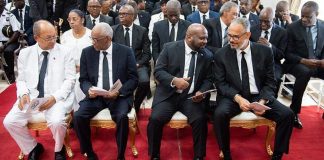
The presence of the USS Southland comes as tensions continue to rise ahead of Feb. 7, the date marking the end of the mandate of Haiti’s nine-member Transitional Presidential Council. Although the council has agreed to step down — and some members have publicly said they would—others have continued to involve themselves in transition plans, despite warnings from U.S. officials that their term will end on Saturday.
The USS Stockdale is an Arleigh Burke-class guided-missile destroyer, and is now among several warships the Trump administration has deployed into the Caribbean. Its powerful design, equipped with advanced combat systems, allows it to carry out multiple roles, including anti-air, anti-surface and anti-submarine warfare.
Haiti remains at a difficult crossroads over a political vacuum as Haitians appear unable to arrive at a consensus over how the country should be governed after Feb. 7. There are at least five different groups engaged in discussions, Antoine Rodon Bien-Aimé, a former member of the Lower House of Deputies, said during a morning interview on Magik9 radio in Port-au-Prince.
On Sunday and Monday, Bien-Aimé attended a dialogue sponsored by three members of the council—Louis Gérald Gilles, Leslie Voltaire and Edgard Leblanc— and described a chaotic discussion in which some of them were still trying to be involved in the transition after Saturday, and others were campaigning for future political posts.
The three members are among five on the council recently hit with U.S. visa restrictions after ignoring warnings against trying to remove Prime Minister Alix Didier Fils-Aimé, and being told that their mandate will expire on Saturday.
“We said, ‘No, not one member of the [council] can remain,’” Bien-Aimé said. “Their time is up; they did not give results, they did not respect their accord, what they signed; they have to leave. This is why we were present and will be present to continue to ask for their departure.”
The council was created in April 2024 as a temporary entity to exercise the powers of the presidency until either a new president is elected or until Feb. 7, whichever comes first. Haiti has scheduled elections for this summer, though few experts expect they will be held amid continuing gang violence.
The political uncertainty, combined with weekend rumors of a possible return to Haiti by former President Michel Martelly and concerns about mobilizations by some groups, has raised fears that Haiti could once again descend into violence, despite recent efforts by police and a drone task force to reopen roads and push back armed gangs in the capital.
Those anti-gang operations have produced some limited gains. At the same time, deadly violence has continued. On Jan. 29, a 4-month-old boy was among the latest victims, killed by armed gangs in the hills above the capital in Kenscoff. He was wearing a Santa outfit.
On Sunday, members of the Viv Ansanm gang coalition who were engaged in a shootout with police, attacked the FIFA soccer goal center, known as the Ranch, in nearby Croix-des-Bouquets. The facility is regarded as “a national, sporting and entertainment heritage” for its role in developing some of the country’s most talented male and female soccer players.
The facility was vandalized, looted and partially burned. The attack was confirmed by the Ministry of Youth, Sports, and Civic Action, which in a statement said it was dismayed to learn of the arson attack on several buildings at the Ranch during Sunday night.