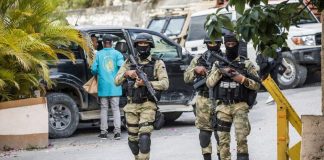

When armed gangs shattered four months of relative calm in Haiti’s Lower Artibonite region last month, the violence didn’t just claim lives. It also added to the pressures of an already strained humanitarian system.
The attacks, along with the ongoing violence in the Center and West regions forced another 20,000 people to flee their homes. Many, according to the United Nations’ International Organization for Migration, were fleeing for the second time.
“Clearly the situation in the Artibonite, and in Port-au-Prince, remains very volatile,” said Grégoire Goodstein, the organization’s chief of mission for Haiti, where the U.N. agency tracks the internally displaced and provides emergency aid.
As gangs expand their reach across multiple regions of Haiti, the displacement of people from their homes is rising in ways that are less visible but no less severe. While some Haitians are moving in with already overburdened host families, others still find their way into increasingly unsanitary camps, where people describe nights punctuated by gunfire and the constant fear of armed groups roaming nearby.
“People are extremely on edge and just can’t take it anymore,” Goodstein said.
Over the weekend, a new region of Haiti came under attack when armed men killed a deaf man on Saturday in the rural town of Seguin. They returned on Monday evening, according to Mayor René Danneau, executed seven people and set their bodies on fire. The armed men also burned the local police station and a police vehicle and stole livestock, adding to the already distressing outlook of widespread hunger remaining in Haiti through the end of June.

U.N. aid groups are struggling to keep up with Haiti’s deepening crisis. The number of Haitians uprooted by gang violence has climbed to about 1.45 million, nearly matching the 1.5 million who were displaced by Haiti’s devastating 2010 earthquake. But Goodstein said the similarities end there.
After the earthquake, there was a degree of predictability and a recognition that rebuilding would take time, he said.
“Now, with all the cuts, that predictability doesn’t exist anymore. It’s just immediate assistance, and it’s piecemeal,” Goodstein said. “That’s the scary part. We don’t know to what extent we’ll be able to assist people in six months’ time.”
Needs are vast
The needs in Haiti are vast. Of the 6.4 million people requiring humanitarian assistance, 5.7 million are facing acute hunger. This year, the U.N. is seeking $880 million to reach 4.2 million of the most vulnerable Haitians, slightly less than last year’s $908 million.
After receiving only 27 percent of its funding last year, Edem Wosornu, who heads the crisis response division of the U.N. Office for the Coordination of Humanitarian Affairs, is hoping that this year the response will improve.
Speaking to reporters last week after a recent four-day visit to Haiti, she described a rapidly worsening crisis with the country “facing one of the most severe and rapidly deteriorating humanitarian crises in the Western Hemisphere.”
Families are skipping meals, children are leaving schools to help support their households and daily life is becoming increasingly uncertain, she said. The 1.45 million displaced Haitians represents 12 percent of the population.
“These are not abstract figures,” said Wosornu. “These represent families, uprooted. Families displaced, separated children, many who’ve lost their homes.”
At one site she visited, 2,800 people were sheltering in a school that once held 400 students. Across the country, roughly 1,600 schools have been shuttered because of violence, leaving about 250,000 children without access to education.
“Where I was walking is where people said, ‘We sleep here at night,’“ she said. “They described at night venom, roaches coming out, rashes on the skin of children, people showing you things” they never experienced in their homes.
Goodstein thinks the worsening sanitation problems reflect the country’s dwindling resources.
“We’re not able to provide the water and sanitation services that we would initially like to,” he said describing seeing fleas and rat bites on people when he visits the overcrowded camps.
Additional pressures emerging
Haitians want to go home, he said, but they also want guarantees that it will be safe for them to return.
The U.N. agency is also preparing for challenges with the coming hurricane season, which starts in June. The aid group also helps deportees returned from the neighboring Dominican Republic and the Caribbean, which are adding to the strain.
Wosornu, who visited the border during her visit, said the U.N. agency is “doing a phenomenal job” at addressing the deportations.
“Last year, the U.N. humanitarian community reached 3 million people with life-saving assistance, a significant achievement given the horrendous and difficult operating environment,” she noted.
Earlier this month, an advanced team from Chad, part of the new gang-fighting force backed by the U.S. and the U.N., arrived in Port-au-Prince, where hundreds of additional personnel are expected in the coming days.
The anticipated arrival of the new international mission is offering hope but rainsing concerns as well. Aid workers hope security forces will be able to retake neighborhoods from armed groups, but also worry that the operations could push gangs deeper into more remote areas, making access to vulnerable populations even harder.
“We’re entering a moment of very high unpredictability and reduced funding,” Goodstein said.
The social strain is also deepening. Aid workers report hearing terms like “gang babies” used to describe children born in areas under gang control — a reflection, they say, of growing stigmatization.
“What we’re seeing also is that people who are leaving from gang-controlled areas are not necessarily being welcomed by those who have left those areas and sought refuge in safer areas,” Goodstein added.
‘More violence’
While there is hope that the new Gang Suppression Force will start operations against the gangs in earnest, there is also concern about what this means for reaching those in need of humanitarian assistance.
“Logically, that will lead to more violence, more volatility and more displacement. We don’t yet know how we will be able to operate, but what we are hoping for sure is that by the end of this year, some of the people that we’re seeing in these sites will be able to go home.”
In the meantime, new waves of violence continue to drive displacement. In recent weeks, attacks in the Artibonite region forced the U.N, migration agency and its partners to respond repeatedly, distributing emergency supplies to hundreds of households.
“I do feel there has been some progress in certain zones,” Goodstein said. But what will ultimately determine a return to neighborhoods that people have fled is “there has to be some, police presence, 24/7… I think that is the criteria number one, and then everything else will need to follow.”