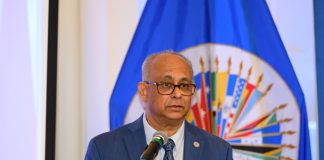

The Secretary General of the Organization of American States (OAS), Albert R. Ramdin, today presented an update to member states on the Organization’s work in support of Haiti, highlighting concrete progress in political facilitation, electoral preparation, security support, international coordination, and strengthening the Organization’s institutional presence in the country.
During his remarks, the Secretary General underscored that the OAS’s efforts have focused on supporting Haitian-led solutions, strengthening coordination among national and international actors, and advancing toward a more structured implementation phase of the Roadmap for Stability and Peace in Haiti.
“We committed to making the OAS’s work in support of Haiti more structured, coordinated, and results-oriented, and developments confirm that we are moving in the right direction. But the work continues: the next phase will be defined by implementation, and it will require sustained political commitment, operational follow-up, and continued strengthening of coordination among national and international stakeholders,” said the Secretary General.
Among the key achievements presented, the Secretary General highlighted the OAS’s political support during the period leading up to and following February 7, 2026, a time of significant institutional uncertainty in Haiti. Through its good offices, quiet diplomacy, and coordination with Haitian, regional, and international actors, the Organization helped preserve executive continuity and avoid a deeper institutional rupture.
On electoral matters, the Secretary General noted that the adoption of the Electoral Decree in December 2025 made it possible to move from general intent to a more organized preparation of the electoral process. Through the Department of Electoral Cooperation and Observation, the OAS maintains a technical working group with the Provisional Electoral Council to address cooperation requests, particularly in areas related to electoral technology, information systems, and institutional capacities.
In the area of security, the Secretary General reported that the OAS’s support has evolved toward more operational forms of assistance, including support for the civilian component of the Gang Suppression Force (GSF), as well as initiatives aimed at strengthening police capacities, infrastructure, specialized training, financial investigations, and maritime and port security.
The Secretary General also highlighted progress in the development of the Haiti Roadmap Dashboard, conceived as a tool to provide greater visibility, traceability, and clarity regarding the contributions and progress of the international community. The first phase, focused on OAS projects, has already been completed, and the second phase seeks to incorporate information on member states’ support. In this regard, he called on delegations to submit pending information so that their contributions can be systematized on the platform and more fully reflect the collective support for Haiti.
For his part, Haiti’s Permanent Representative to the OAS, Jean Josué Pierre, confirmed that the report presented by the Secretary General reflects the reality on the ground and emphasized that “today there are in Haiti still modest signs, certainly, but very real signs of hope, indicating that things are beginning to change and that life, peace, and security are gradually seeking to reclaim their place in the Haitian capital.” He further stressed that “the moment now requires consolidating these advances and scaling up efforts,” and announced the submission of a draft resolution entitled “Support for Haitian-Led Stabilization and Strengthening Coordination of Hemispheric Assistance,” which will be debated at the OAS General Assembly to be held in Panama in June.
The Secretary General also announced that prior to the OAS General Assembly, which will take place in Panama from June 22 to 24, a new meeting of the Group of Friends of Haiti will be convened to review progress, align next steps, and mobilize support around the priorities identified in the Roadmap.
During the session, the Secretary General also introduced Alberto Föhrig, appointed as the Secretary General’s Special Representative for Haiti and Head of the OAS Special Mission. He noted that this appointment strengthens the continuity, visibility, and strategic follow-up of the Organization’s work in support of Haiti’s defined priorities.
The OAS Special Mission seeks to provide a more structured and sustained mechanism to support the implementation of the Roadmap, facilitate political dialogue, support coordination among Haitian and international actors, and contribute to the follow-up of priorities related to stabilization, security, and democratic restoration.
“The road ahead will continue to require determination, coordination, and a shared sense of purpose. The OAS stands ready to continue contributing to this effort as a platform for alignment, a facilitator of dialogue, and a partner in implementation,” concluded the Secretary General.
The Permanent Council took note of Secretary General Ramdin’s presentation, and the Chair of the Council and Permanent Representative of Costa Rica to the OAS, Alejandra Solano, requested that he continue to keep the Permanent Council informed on developments regarding the situation.
The Roadmap for Stability and Peace in Haiti continues to serve as the main framework guiding the support of the OAS, member states, and international partners to Haitian priorities in the areas of security, democratic governance, elections, institutional coordination, and resource mobilization.
Reference: E-058/26