

Haiti just won the fashion World Cup

Date:

The Caribbean country is taking part in the tournament for the first time in 52 years.
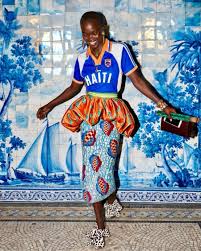
In a surprising turn of events, Italy never qualified for this summer’s World Cup, and Haiti did. For the first time in over 50 years, the Caribbean country will compete in the global tournament, which kicks off in a matter of weeks. It will mark Haiti’s second ever appearance at the event – the only other time it took part was in 1974. 

To celebrate this historic moment, Haitian-Italian fashion designer Stella Jean is releasing a series of special-edition, hand-stitched football jerseys. Each one has the number 26 printed on the back, an ode to the 2026 tournament. “It marks a year of rebirth,” says Jean. “52 years later, we celebrate Haiti shining again on football’s biggest stage. It’s never too late to rise,
 to lift our heads and make the impossible visible.” 

It’s the second time Team Haiti has made headlines this year. Back in February, Jean designed Team Haiti’s Winter Olympics kit, which undeniably became the standout uniforms of the entire Games. “We are one of the smallest, poorest delegations, but in this Olympic arena, we will be equal to all the others. We are so much more than the tragedy that we are living right now,” Jean told Dazed at the time, referring to the country’s continued political unrest.

This time round, it’s not just the Olympians that can wear Stella Jean’s sportswear. The designer’s football jerseys are available to pre-order now, here, just in time for the World Cup. “Wear it the Haitian way: 
bold,
 proud,
 unbreakable,” she says. “If your flag does not fly this season, stand anyway. Stand for Haiti.
 Stand for all who still hunger for the only revolution needed: peace.” 

Share post:

Les + Populaires

Plus d'Articles
Similaires

Le secrétaire d’État adjoint des États-Unis, Christopher Landau, reçu au Palais national

le secrétaire d’Etat américain a fait un compte rendu de sa visite en Haïti, en notant un changement notable de la situation sécuritaire. “Lorsque notre administration a pris ses fonctions il y a seize mois, Haïti était au bord du gouffre, menacée par de violents gangs criminels qui risquaient de prendre le contrôle du pays et de provoquer un effondrement social total ainsi qu'un nouvel afflux de migrants (qui s'ajouteraient à ceux que l'administration Biden avait activement encouragés à venir). La situation est aujourd'hui radicalement différente”, a-t-il fait remarquer.

U.S. Deputy Secretary of State Landau visits Haiti amid deadly surge in violence

Deputy U.S. Secretary of State Christopher Landau visited Port-au-Prince on Friday on a last-minute trip during which he observed a shooting exercise involving members of the newly created Gang Suppression Force, which has yet to be fully deployed, and met with Prime Minister Alix Didier Fils-Aimé. Landau’s visit comes at a particularly difficult moment for Fils-Aimé and residents of the capital and surrounding regions, where armed gangs have been tightening their grip and expanding their control; the country’s long-overdue elections increasingly look unlikely to take place this year.

Haïti et ses crises électorales

Depuis 1987, date de la tentative d’organiser les premières élections démocratiques en Haïti, les crises électorales avant, pendant ou après les scrutins, se sont succédé. Rares sont les élections sans crises et les crises sans une élection au bout des aventures. L’une nourrissant l’autre pour donner naissance à nos insatiables transitions.  Il est encore temps d’éviter la prochaine catastrophe électorale. Pour cela, il faudra de la pédagogie, de la simplification et des institutions au-dessus de tout soupçon. Pas d'approximation, pas d'omission, pas d’arrière-pensée.

La FRG annonce des opérations imminentes contre les gangs

La Force de répression des gangs (FRG) a annoncé qu’elle se trouve dans la phase finale de ses préparatifs avant le lancement de ses opérations en Haïti. Cette annonce intervient dans un contexte de détérioration continue de la situation sécuritaire, notamment à Port-au-Prince ainsi que dans plusieurs autres régions du pays, où les violences armées continuent de provoquer peur, déplacements de population et instabilité.