
More than a month after U.S. forces removed Venezuelan leader Nicolás Maduro from power, and amid a tighter U.S. embargo on Cuba and heightened boat strikes in the region, Caribbean leaders are preparing to meet with U.S. Secretary of State Marco Rubio this week.
Rubio is scheduled to attend the 50th annual meeting of the heads of governments of the Caribbean Community, CARICOM, in Saint Kitts and Nevis, the State Department said. The conference runs from Tuesday to Friday, with the secretary of state scheduled to attend on Wednesday.
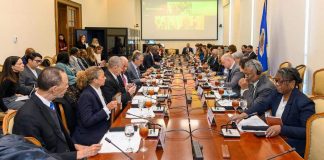
Chaired by Saint Kitts and Nevis Prime Minister Terrance Drew, the conference will bring together the heads of government from 15 Caribbean nations as well as the prime ministers and premiers from non-independent Caribbean territories.
The State Department said Rubio is expected to engage in discussions on regional security, combating illegal immigration and drug trafficking, and promoting economic growth, health and energy security across the Caribbean. This will be Rubio’s first meeting with the entire CARICOM bloc. Shortly after becoming secretary of state he traveled to Jamaica, Guyana and Suriname in March of last year. During the visit he focused on irregular migration and drug trafficking in the region, and also met with the the leader of Haiti’s transitional presidential council during his stop in Jamaica.
His first official visit to the eastern Caribbean comes as the Trump administration steps up pressure in the region and seeks to find more third countries willing to take in migrants from the United States who cannot return to their home countries. Saint Kitts is among several Caribbean nations that have agreed to accept asylum seekers turned away from the United States.
Drew was rebuked last month when he announced that his nation had signed a third-party agreement with the Trump administration, but had asked for Haitian migrants to be excluded from those sent to his country.
It’s unclear if Haitian officials will raise the matter with Drew. On Monday, Haitian Prime Minister Alix Didier Fils-Aimé announced the signing of a document outlining a legal and political framework for establishing stability and security and organizing elections.
The pact is the result of weeks of negotiations with political parties and civil society groups with Fils-Aimé, who became Haiti’s sole leader earlier this month after the mandate of the ruling nine-member transitional presidential council ended without elections. The agreement focuses on effective governance and so far enjoys broad support from most major political parties and coalitions.
One political party, the Fusion of Haitian Social Democrats, raised concerns about the process, saying it was not the result of “genuine negotiations,” but more a “Take it or leave it” process. “The party considered it essential to avoid a vacuum at the head of the state. Your continuation in office, along with the government you lead, appeared to be the least detrimental solution to the political deadlock of February 7. It was a circumstantial choice, not a blanket political endorsement.,” the group wrote in an open letter to Fils-Aimé.
In a ceremony Monday, Fils-Aimé described the agreement as “a contract” designed to put the country on the road toward stability, elections and security. “The stability of a country doesn’t depend solely on security in the streets and the neighborhoods,” he said.
The pact doesn’t provide an end date for the current governmental transition, the third since the July 7, 2021, assassination of President Jovenel Moïse plunged the country deeper into instability.