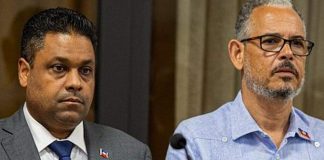

Haitians woke up Thursday under a cloud of uncertainty as the country’s fragile political transition descended into open confrontation, with the sides locked in a standoff and neither appearing willing to back down.
With just days remaining until its mandate ends, Haiti’s Transitional Presidential Council is seeking to remove Prime Minister Alix Didier Fils-Aimé from office. Such a move would create a dangerous political vacuum—one the United States and other international partners are anxious to avoid—and could open the door to renewed instability at a moment Haiti’s security forces have begun to make measurable gains against armed gangs.
Since December, Haitian police, supported by a newly deployed drone task force, have pushed back gangs and re-entered neighborhoods where authorities had not operated since 2018. In one dramatic operation, security forces bombed two homes belonging to gang leader Jimmy “Barbecue” Chérizier. In a video posted afterward, Chérizier—a former police officer—appeared visibly shaken as he appealed to current members of the force.
With so much at stake, the U.S. Embassy in Port-au-Prince, in unusually blunt language, issued a warning late Wednesday that was later echoed by U.S. Deputy Secretary of State Christopher Landau. In essence, the statements warned that members of the “unelected” presidential council were walking a dangerous line days before their mandate is set to expire on Feb. 7.
“The U.S. objective for Haiti remains the establishment of baseline security and stability,” Landau wrote in a post on X that mirrored the embassy’s statement. “The United States would regard any effort to change the composition of the government by the non-elected Transitional Presidential Council at this late stage in its tenure… as an effort to undermine that objective.”
Landau added that Washington would view anyone supporting such a move as favoring armed gangs and acting against the interests of the United States, the region and the Haitian people, warning that the U.S. “will act accordingly.”
So far, the warnings seem to have had little effect. One of the members of the nine-member council, Smith Augustin, confirmed in a text to Le Nouvelliste newspaper that he and four others had voted to oust Fils-Aimé. The other four members are said to be Leslie Voltaire, Gerald Gilles, Fritz Alphonse Jean and Edgard Leblanc Fils. Sources told the Miami Herald that a second resolution is also in the works to remove the council’s coordinator, Laurent Saint-Cyr, who since last month had fought against the firing.
Human rights advocate Pierre Esperance called the moves “a suicide mission that isn’t going to take the country anywhere.”
In an interview with Magik 9 on Thursday morning, Esperance predicted that Saint-Cyr would not send the resolution to the secretary general of the presidency to make the firing official after being published in the country’s gazette, Le Moniteur.
If by some chance the resolution is forwarded, Esperance called for the Army and the Haiti National Police “to make every effort to take control of Villa d’Acueil” — the old prime minister’s office where the council works from. As prime minister, Fils-Aimé heads the entity that oversees Haiti’s security forces.
Esperance called for the government to “remove all” of the presidential council’s security “because they have no authority, morality, integrity and legitimacy to do what they’ve done.” He accused the council members of acting out of self-interests and not “nationalism.”
Haiti’s political parties and civic groups have moved to distance themselves from the presidential council as it faced bribery and corruption allegations and come under scrutiny over alleged ties to armed gangs.
“Now at the moment they are supposed to leave, they want to install a prime minister so that they can stay,” Esperance said, noting that the seven voting members of the council have various plans to remain in power after Feb. 7.
In addition to targeting Fils-Aimé, council members also want to remove police chief, Vladimir Paraison, and the head of the Anti-corruption agency, Hans Joseph, who early in the transition investigated three of the council members on allegations of bribing the head of a state-owned bank, and recommended that they be prosecuted.
Members of the council have not publicly stated why they want Fils-Aimé out. But tensions have been brewing for some time, with efforts to remove both the prime minister and Saint-Cyr began intensifying last month as discussions about the end of the council’s mandate on Feb. 7 got under way.
In agreeing to lead Haiti’s transition in April 2024, the seven voting members and two observers agreed that they would leave office on Feb. 7. Though the goal was to hand power at that point to an elected government, the first round of elections is now scheduled for this summer.
Some members of the council have decided that Fils-Aimé has not done enough to assure them a place in the country’s governance after Feb. 7, or protection from possible sanctions by the U.S. and other nations.
In December, the council issued a decree granting members immunity from future prosecution for actions taken while in office. Days later, it approved another decree expanding Haiti’s criminal defamation laws, potentially opening the door to prosecutions of journalists and other critics.