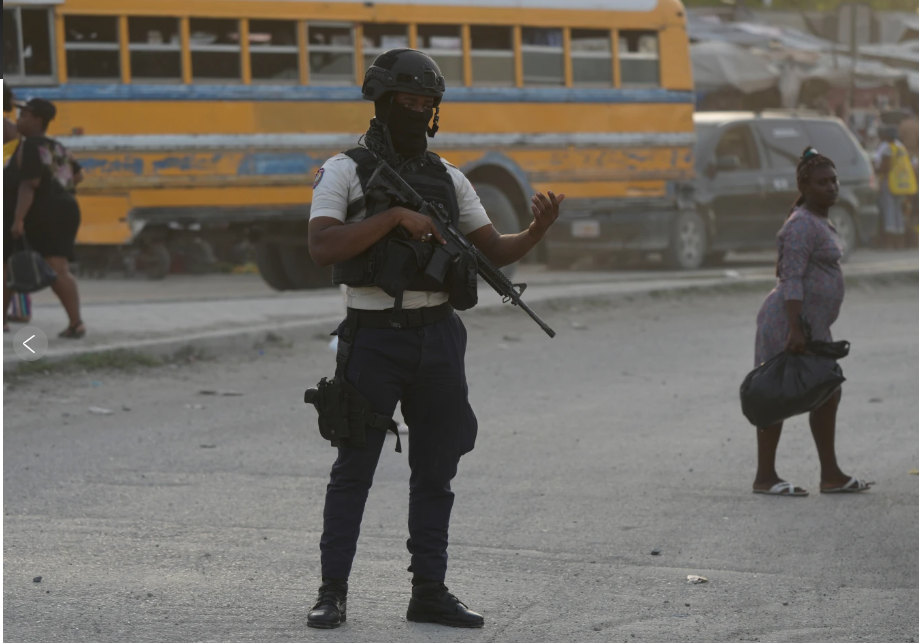

Haiti police chief says a plan is underway for elections this year despite gang violence

Date:

People watch police work a crime scene after a foiled attempted kidnapping in the Delmas district of Port-au-Prince, Haiti, Monday, Feb. 23, 2026. (AP Photo/Odelyn Joseph)

PORT-AU-PRINCE, Haiti (AP) — The head of Haiti’s National Police told The Associated Press on Friday that authorities are still working on a plan to safely hold general elections this year as promised by the government, despite persistent gang violence.

André Jonas Vladimir Paraison, who became the department’s interim head in August, said he could not provide more details but would release more information soon.

“We have a plan for the election, but it’s still in the kitchen and has not finished cooking yet,” he said.

When asked if he felt Haiti would be ready to hold elections this year, Paraison side-stepped the question.

Haiti’s government has said it plans to hold general elections in late August and a runoff in early December. On Friday, the Provisional Electoral Council announced that it plans to open registration for political parties and their candidates starting March 2 until March 12.

It’s been more than a decade since Haiti last held a general election, and gang violence has only worsened since President Jovenel Moïse was killed in July 2021 at his private residence.

Paraison said Haiti’s situation has “exploded,” but that police officers are working to reestablish security so Haitians can resume their lives.

Gang violence has displaced a record 1.4 million people in a country of nearly 12 million inhabitants, with armed men controlling an estimated 90% of Port-au-Prince, the capital, and seizing swaths of territory in the country’s central region.

The violence also has forced thousands of businesses and hundreds of schools to close.

More than 5,900 people were reported killed last year and more than 2,700 injured, according to U.N. statistics.

Paraison said he hopes to boost the number of officers to better protect Haitians. He recently oversaw the gradation of nearly 900 cadets but said more are needed.

U.N. officials have said that Haiti in recent years had less than two officers per 1,000 inhabitants, well below the international standard.

Despite a depleted force, Paraison has overseen recent operations in the heart of gang-controlled territories, retaking areas including Carrefour-Aéroport, a key intersection.

Police also are issuing more statements about the number of suspected gang members killed during those operations.

Paraison noted that gangs are heavily armed and have a surplus of guns and ammunition. “Don’t forget, Haiti doesn’t make weapons. The weapons here come from somewhere else,” he said.

Experts have previously estimated that there could be as many as half a million small arms in Haiti, while a 2023 U.N. report found that increasingly sophisticated weapons including .50 caliber sniper rifles and even belt-fed machine guns are smuggled into Haiti mainly from the U.S., especially Florida.

Haiti’s National Police are working alongside a U.N.-backed mission led by Kenyan police that has remained underfunded and understaffed as it continues to fight gangs. A so-called gang suppression force is expected to replace the mission in upcoming months.

___

Associated Press reporter Dánica Coto in San José, Costa Rica contributed.
Share post:

Les + Populaires

Plus d'Articles
Similaires

Haïti : la violence des gangs gagne les campagnes, sur fond de report des élections

En Haïti, les forces de sécurité intensifient leurs opérations, mais les gangs ne désarment pas. Ils adaptent leurs tactiques, multiplient les représailles contre les populations et portent la violence jusque dans les campagnes. Entre juillet et début octobre, 1 123 personnes ont été tuées et 440 blessées dans des violences liées aux gangs, selon le dernier rapport du Secrétaire général de l’ONU, présenté lundi au Conseil de sécurité.

Haïti- UN : la GSF dépasse les 2 000 hommes, mais les gangs défient toujours l’État et les élections s’enlisent

Malgré le renforcement de la présence internationale et l’intensification des opérations contre les gangs armés, Haïti reste confrontée à une crise sécuritaire majeure. Devant le Conseil de sécurité des Nations unies, lundi, les responsables onusiens ont reconnu les progrès réalisés par la Force de répression des gangs (GSF), tout en soulignant les contraintes logistiques qui freinent son déploiement, l’ampleur des violences et la nécessité de rendre crédible le processus électoral. La réunion s’est également déroulée dans un contexte particulièrement tendu, après une embuscade visant des membres du contingent salvadorien de la GSF en Haïti, dimanche. Les circonstances de l’attaque et le sort des soldats signalés comme manquants demeuraient au cœur des préoccupations exprimées devant le Conseil.

Gangs in Haiti target foreign troops in biggest attack since new force began operations

Gangs in Haiti have opened fire on an armored vehicle, leaving four soldiers from El Salvador unaccounted-for in the first major attack since an international gang suppression force began operations in the violence-wracked country. The attack occurred Sunday in Croix-des-Bouquets, a once peaceful community in Port-au-Prince now controlled by violent gangs. The Armed Forces of El Salvador said in a statement Monday that the four aviation technicians were returning to camp when the armored vehicle was attacked with explosives and set on fire.

Haïti : élections, sécurité, sanctions et Global Gateway: Hélène Roos répond à 15 questions sur l’action de l’Équipe Europe

"De notre côté, comme partenaire, nous prenons nos responsabilités : l’Union européenne dispose d’un régime de mesures restrictives à l’encontre de personnes et d’entités considérées comme responsables d’actions menaçant la paix, la stabilité, ou la sécurité d’Haïti, ou portant atteinte à la démocratie et à l’État de droit. Ce régime n’est pas un instrument électoral et les sanctions européennes ne constituent pas, en elles-mêmes, des critères d’éligibilité au regard du droit haïtien. Elles consistent en revanche en une liste de personnes qui sont interdites d’entrée sur le territoire de l’Union européenne, soit dans ses 27 États membres, ainsi qu’en la possibilité degels d’avoirs. "...