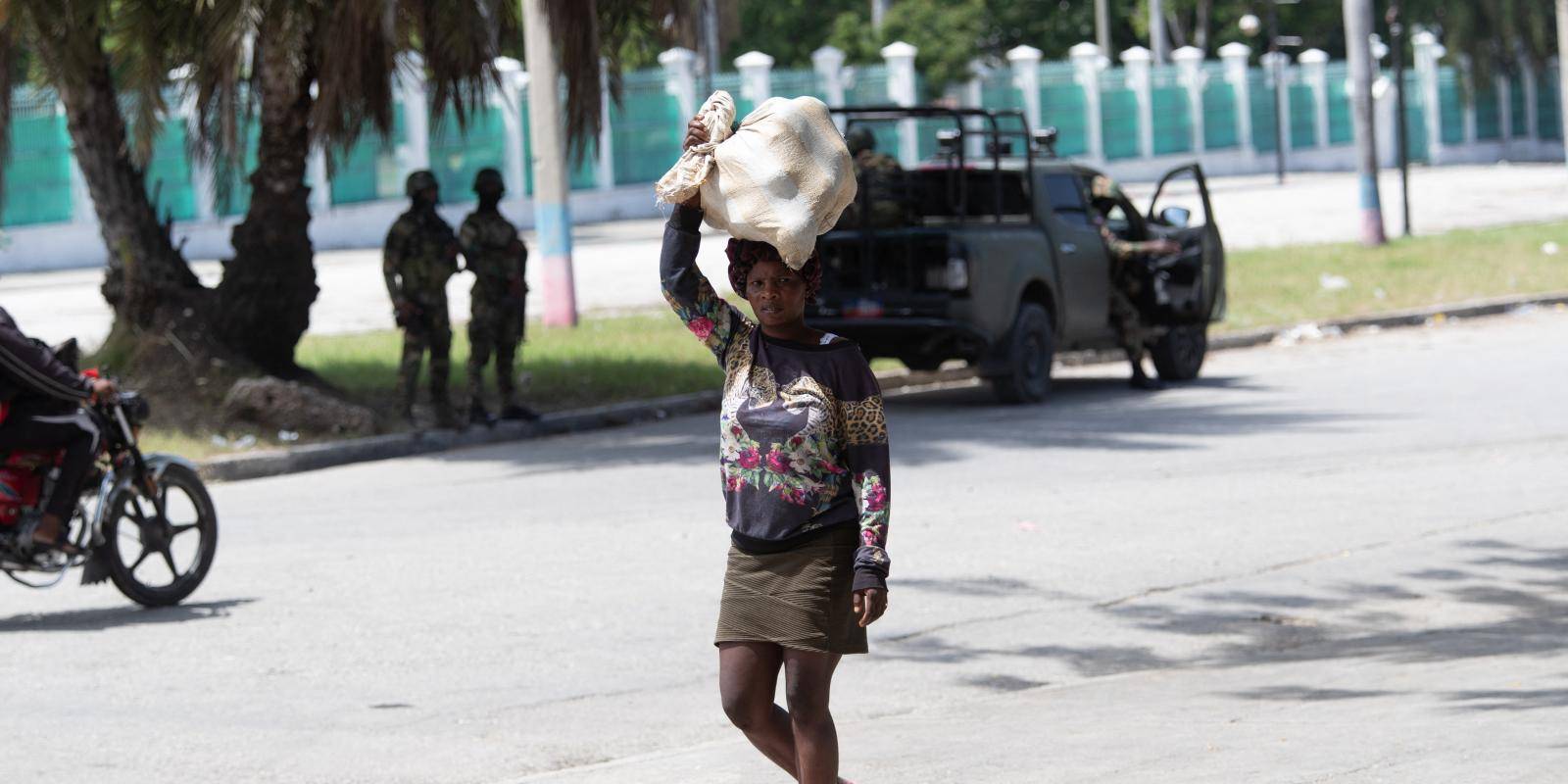

PORT-AU-PRINCE, Haiti (AP) — Radios across Haiti were abuzz on Wednesday with the news that the U.N. Security Council had approved the creation of a so-called gang suppression force to help the troubled Caribbean country.
The force would replace a smaller U.N.-backed mission led by Kenyan police that remains understaffed and underfunded and whose mandate expires on Oct. 2.
“I’m hoping these people are serious this time,” said Darlene Jean-Jacques, who lives with her 10-year-old son in a crowded and filthy shelter after gangs raided their neighborhood and killed her partner. “A force to come and support Haitians would be wonderful so people can have their life back.”
Gangs have grown in power since the assassination of President Jovenel Moïse in 2021. They now control 90% of the capital, Port-au-Prince, and have expanded their activities, including looting, kidnapping, sexual assaults and rape, into the countryside. Haiti has not had a president since the assassination.
But Haitians and experts alike remain cautious about yet another international force, that was approved Tuesday.
A gap in security
Little is known about the deployment timeline of the new force, which would have 5,550 personnel, a 12-month mandate and the power to arrest suspected gang members, something the current force lacks.
“There are some answers and still a lot of uncertainty,” said Diego Da Rin, an analyst with the International Crisis Group.
The U.S. government has said it’s confident there’ll be enough troops to send to Haiti between Africa and the Western Hemisphere, but “some observers doubt it will be so easy,” Da Rin said.
A U.N. Support Office would guarantee money for the mission, but the salaries of the personnel will rely on voluntary contributions, and there have been no meaningful negotiations on who would be ready to provide those funds, he said.
Another major concern is how the current mission will transition into a gang-suppression force.
Ongoing discussions estimate that the new force could be on the ground and operating within a year, but there’s currently not enough money to keep the service contract that provides the current mission with food, accommodations and other services going beyond this year, Da Rin said.
That vacuum in security, he noted, could be problematic.
‘International community failed’
Like many other Haitians, Mario Jean-Baptiste has been living in an overcrowded shelter with his three young children since gangs destroyed their Solino neighborhood last year.
“It’s a good thing that a new force is coming in, but I hope they’re not like the jokers who are here,” he said of the current mission in Haiti. “We need people who are really going to go after these guys so that one day we’ll be able to go back home.”
The current mission began more than a year ago, but it still has less than 1,000 personnel, far below the 2,500 envisioned, and some $112 million in its trust fund — about 14% of the estimated $800 million it needed annually.
“The international community failed Haiti with (that mission),” Da Rin said. “It didn’t have the opportunity to demonstrate whether it was effective or not.”
However, he said the Kenyan force helped slow the advances of gangs that control about 90% of Port-au-Prince and have seized numerous communities in Haiti’s central region.
“They call themselves revolutionaries,” Jean-Baptiste said of the gangs. “They’ve only destroyed my life.”
The gang that raided his neighborhood also burned a small bus he rented to use as a taxi, leaving him without any income.
“I can’t send my kids to school,” he said. “I don’t foresee any money anytime soon so they can get an education.”
‘Decisive’ months ahead
Gang violence has left a record more than 1.3 million people homeless across Haiti in recent years, and hunger and poverty are only deepening.
Millions of Haitians remain frustrated that their situation has not improved despite the promise of a new international force.
“They’re not going to come here to do anything!” yelled a woman, who only identified herself as Estere before she walked away at a makeshift shelter.
But Haitian and U.S. officials remain hopeful.
U.S. Secretary of State Marco Rubio said the U.S. government would work with others to ensure the “swift deployment” of the gang suppression force.
The new force “will address Haiti’s immediate security challenges and lay the groundwork for long-term stability,” he said.
Romain Le Cour, head of the Haiti Observatory at the Global Initiative Against Transnational Organized Crime, said: “The adoption of the resolution sends a message to criminal groups and their potential supporters. The coming months will be decisive for the future of the country.”
___
Coto reported from San Juan, Puerto Rico.