
PORT-AU-PRINCE, Haiti (AP) — Haiti’s government opened a 10-day registration period Monday for political parties to run in an upcoming general election, a critical step for a country that hasn’t held one in more than a decade as deadly gang violence persists.
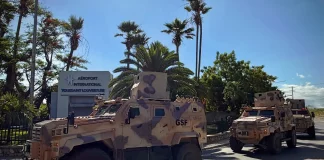
Heavily armed soldiers and police surrounded the headquarters of Haiti’s Provisional Electoral Council as a handful of political operatives for long-established parties picked up the necessary paperwork.
Joining them was Pierre Dieu-Donné Delice, a psychologist who heads a new party called Tools for Another Haiti. Delice told The Associated Press that he and other party members are tired of the transitional government in power since President Jovenel Moïse was killed at his private residence in July 2021.
“They love transition because there’s no control. They can do whatever they want,” Delice said of Haiti’s current government.
Prime Minister Alix Didier Fils-Aimé is the current interim leader of the troubled country where gangs control an estimated 90% of Port-au-Prince and swaths of land in the central region.
He has the backing of the U.S. government and used to share power with a transitional presidential council that was established in 2024, nearly three years after Moise was killed. The council stepped down on Feb. 7 as required by law, leaving Fils-Aimé as the sole leader of the country.
Haiti’s government has pledged to hold a general election in late August and a runoff by early December, but it’s unclear if that will happen.
“The conditions are not ready yet for an election,” lamented Delice, leader of the new party, noting that gang violence persists in several regions. “There is no way for candidates to campaign there. … If the situation stays the way it is now, it will be impossible to have an election.”
More than 5,900 people were reported killed last year across Haiti and more than 2,700 injured, according to U.N. statistics.
Gang violence also has displaced a record 1.4 million people in a country of nearly 12 million inhabitants.
Delice himself had to flee his home in the central coastal town of Arcahaie with his family after heavily armed gangs attacked it.
He also had to move his party’s headquarters from his hometown to Port-au-Prince, and said he’s forced to travel by boat or helicopter to meet with regional party members because gangs retain control of the main routes going in and out of the capital, occasionally opening fire on vehicles passing through.
Joseph André Gracien Jean, the minister in charge of electoral matters, celebrated the start of registering political parties on Monday.
“Today, we take a big step,” he told the AP. “People should be elected to return to a democratic order.”
He said the council is not waiting until security is established across Haiti to register parties.
“It’s a long process; step by step, we are moving forward,” Gracien Jean said. “What’s important is that the executive branch is making an effort.”
The registration process ends on March 12, and officials expect the pace to pick up before the deadline.
The head of Haiti’s National Police, André Jonas Vladimir Paraison, recently told the AP that authorities were still working on a plan to safely hold general elections.
In upcoming months, a new gang suppression force is expected to replace a U.N.-backed mission led by Kenyan police that remains understaffed and underfunded.