

Soaring fuel prices driven by the U.S.-Israeli war on Iran risks worsening an already dire situation in Haiti, the International Monetary Fund warned Monday, as a recent hike at the pump renewed protests in gang-plagued Port-au-Prince.
Angry bus drivers took to the streets in the Delmas 33 neighborhood of the capital, blocking roads with their vehicles and setting tires ablaze Monday morning. Later, some passengers were forced to get off buses as protesters denounced the government’s fuel price increase.
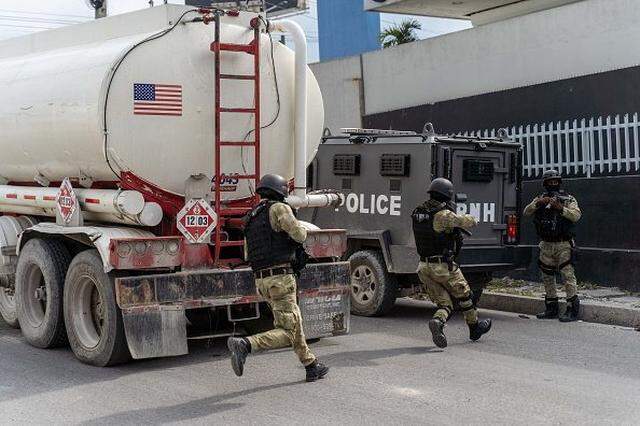
Their concerns contrasted with those of gas station owners in southern Haiti, who say the adjustments do not go far enough to offset gang-related costs. After the Trump administration last year designated the country’s most powerful gangs as foreign and global terrorists, armed groups doubled the charges for the use of roads, and charged tankers to exit the port terminal.
Citing those costs and the continuing violence, gas station owners in the southwestern city of Les Cayes have taken it upon themselves to charge even more than the government-set price at the pump.
With a barrel of crude oil topping $100 on the world market, Haiti’s Ministry of Economy and Finance announced that, as of April 2, gasoline prices would rise by $1.27 a gallon, with diesel and kerosene increasing by $1.77.
As a result, Haitians are now paying the equivalent of $5.58 per gallon of gasoline, $6.54 per gallon for diesel and $6.50 for kerosene — steep costs in a country where the economy has been in a free fall for the last seven years and more than half of its 12 million people are going hungry.
“The oil price shock stemming from the war in the Middle East has emerged as a major headwind, significantly raising the fuel import bill and implicit subsidy cost, and aggravating an already weak fiscal position,” IMF senior economist Camilo E. Tovar said Monday, after he conducted a virtual mission from March 23 to April 1 with Haitian authorities to assess progress of Haiti’s economic program.
Ripple effect
The high cost of fuel is also rippling across a supply chain already hammered by surging gang violence. In the last week, renewed attacks in the country’s breadbasket region have meant that farmers in the Lower Artibonite cannot get their rice and other crops to markets.
The violence has also led to an additional 20,000 Haitians being displaced, on top of the 1.45 million who have been forced to flee their homes, according to the United Nations International Organization for Migration. And there are other shocks.
Hurricane Melissa, which battered Jamaica and Cuba in October, also slammed the southern coast of Haiti. The storm’s heavy rains caused widespread flooding that killed at least 43 people and led to the destruction of banana plantations, sorghum, beans, cassava, coffee and other crops as well as the loss of livestock.
The damage, the IMF said, “exacerbated humanitarian needs,” in the country, which continues to undergo a fragile political transition that is supposed to allow for the first general elections in a decade.
“Haiti is facing an increasingly challenging macroeconomic environment shaped by persistent insecurity and recurrent domestic and external shocks,” Tovar said.
Dip in inflation
Kesner Pharel, a Haitian economist, said the U.S.-Israel war was the last thing Haiti needed. After ending the 2025 budget year with inflation at 32 percent, the country had finally begun to see some improvement amid the intensified fight against armed gangs in Port-au-Prince and increased economy activity. Inflation had fallen to 22 percent in February before the war began, but is now expected to rise again.
“From 32 percent to 22 percent, it was very good for the purchasing power,” Pharel said. “Food prices were going down. Now everything is going to get back to higher prices.”
He expects inflation to climb to between 25 percent to 30 percent over the next six months along with a drop in remittance inflows. The billions of dollars that Haitians send home, the IMF said, have helped the government’s Central Bank reserves, while offsetting the high fuel prices despite the uncertainty surrounding the potential termination of Haitians’ Temporary Protected Status in the United States.
“If gasoline in the states is $4 a gallon that means people will have less money to send to Haiti,” Pharel said. “And if we have less money coming from the states, the Central Bank is going to have fewer reserves because they are using these reserves for the companies to import the petroleum. And the macroeconomic stability we have right now that the IMF is talking about, we are going to lose it.”
‘We didn’t need this’
“We didn’t need this because we have too many problems already,” Pharel added. “The socio-economic situation is going to be very difficult.”
After previous attempts in 2018 and 2019 by the government to raise fuel prices triggered countrywide lockdowns, Haiti was finally able to eliminate fuel subsidies in 2022 under the administration of former Haitian prime minister Ariel Henry. That has resulted in about $22.8 million in savings a month that the government has been able to tap to fund its fight against armed gangs, including hiring drone-operating foreign contractors.
Now, the money may be eaten away by the rising global price of fuel. “They are going to lose that money. It’s going to be very difficult for them to pay salaries in the public sector. It’s also going to be very difficult to get good and services, like public investments,” Pharel said, noting the lack of funds also risks reigniting gang violence.
“It’s a very tough situation we are in because of the war in the Middle East,” Pharel said. “We are too dependent on petroleum.”
The rise in international oil prices are compounding the country’s dire humanitarian and economic situation, the IMF said.
“Against this backdrop, we encourage authorities to deploy their accumulated buffers to help mitigate shocks, preserve macroeconomic stability, and protect the most vulnerable. The recent oil price shock, in particular, underscores the importance of adapting policy implementation as conditions evolve,” the fund said.
Haiti’s gross international reserves are projected to reach about $3.4 billion at end this budget year, the IMF said. Also, the deployment of the new U.S. backed Gang Suppression Force could help restore confidence and support economic activity.
But Tovar warns that “further deterioration in security conditions, together with persistently higher global oil prices, could further strain economic activity, aggravate humanitarian conditions through higher food prices, and intensify fiscal pressures.”