
U.S. Deputy Secretary of State Landau visits Haiti amid deadly surge in violence

Date:

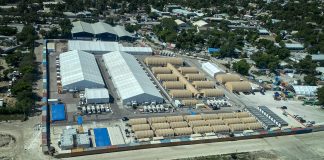
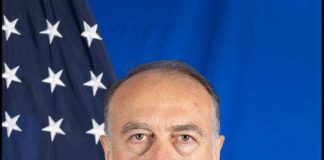
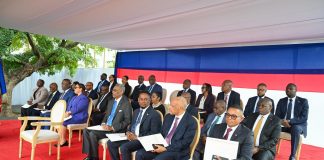
Deputy U.S. Secretary of State Christopher Landau visited Port-au-Prince on Friday on a last-minute trip during which he observed a shooting exercise involving members of the newly created Gang Suppression Force, which has yet to be fully deployed, and met with Prime Minister Alix Didier Fils-Aimé.

Landau’s visit comes at a particularly difficult moment for Fils-Aimé and residents of the capital and surrounding regions, where armed gangs have been tightening their grip and expanding their control; the country’s long-overdue elections increasingly look unlikely to take place this year.

The day before Landau’s arrival, the United Nations reported that nearly 1.5 million people had been uprooted across the country this month amid a deadly surge in gang violence that had also displaced more than 300,000 people in metropolitan Port-au-Prince. The unprecedented displacements in the West region are primarily due to armed clashes in the neighborhood of Cité Soleil in March and May, the U.N. said. Fighting is also driving continued displacement in the nearby Artibonite region.

Aside from the surging violence, the prime minister is facing criticism from political parties over proposed electoral reforms that would increase the number of registered members political parties must have to field candidates for the presidency and Parliament. Also under debate is how to address the issue of individuals sanctioned by the United States, Canada and the European Union.

In a statement announcing the trip, which includes an overnight stop in the neighboring Dominican Republic, the State Department said Landau planned to discuss bilateral cooperation and security priorities with Fils-Aimé.

“The deputy secretary will also engage with personnel in the Haitian national police and the U.N.-authorized Gang Suppression Force to reaffirm U.S. commitment to Haiti’s stability,” the statement said.

During the visit, a new class of 1, 192 police recruits, including 238 women, graduated from the National Police Academy as part of a U.S.-funded effort to expand the country’s force.

Last year the U.S. created and backed the new gang-fighting force to replace the struggling Kenya-led Multinational Security Support mission, which struggled to stabilize Haiti amid equipment shortages, limited troop deployments and insufficient international financial support.

Currently, just under 1,000 troops are in Haiti. The gang-fighting force soldiers have spent the past two weeks undergoing in-country training before launching operations on Monday. The force is not expected to reach its full strength of 5,000 until October.

After his visit to Haiti, Landau traveled to Santo Domingo, where he is scheduled to meet with President Luis Abinader and members of his administration to discuss bilateral relations and regional priorities. He will also meet with private-sector leaders to discuss areas of mutual economic and commercial interest, the State Department said.
Share post:

Les + Populaires

Plus d'Articles
Similaires

Haïti : élections, sécurité, sanctions et Global Gateway: Hélène Roos répond à 15 questions sur l’action de l’Équipe Europe

"De notre côté, comme partenaire, nous prenons nos responsabilités : l’Union européenne dispose d’un régime de mesures restrictives à l’encontre de personnes et d’entités considérées comme responsables d’actions menaçant la paix, la stabilité, ou la sécurité d’Haïti, ou portant atteinte à la démocratie et à l’État de droit. Ce régime n’est pas un instrument électoral et les sanctions européennes ne constituent pas, en elles-mêmes, des critères d’éligibilité au regard du droit haïtien. Elles consistent en revanche en une liste de personnes qui sont interdites d’entrée sur le territoire de l’Union européenne, soit dans ses 27 États membres, ainsi qu’en la possibilité degels d’avoirs. "...

Haïti : le Conseil de sécurité de l’ONU examine lundi la situation sécuritaire et les préparatifs électoraux

Le Conseil de sécurité des Nations unies tiendra lundi 19 octobre une séance publique consacrée à Haïti, suivie de consultations à huis clos, avec au programme la dégradation de la situation sécuritaire, le déploiement de la Force de répression des gangs (GSF) et les incertitudes entourant l’organisation des prochaines élections. Selon Security Council Report, publié le 16 octobre, trois responsables onusiens sont susceptibles de présenter un état des lieux : Carlos Ruiz Massieu, représentant spécial du secrétaire général et chef du Bureau intégré des Nations unies en Haïti (BINUH) ; Jack Christofides, représentant spécial pour la GSF ; et Daniela Kroslak, secrétaire générale adjointe et cheffe du Bureau de soutien des Nations unies en Haïti (UNSOH), dont la participation au briefing reste possible.

Martelly puts elections rumors to rest, registers to run for Haiti presidency

Former Haitian President Michel Martelly has registered to run for the presidency of the Caribbean nation, joining a growing list of candidates hoping to lead a troubled Haiti despite facing sanctions from the United States, Canada and the European Union — or in the case of the former singer, all three. Martelly’s name was among 16 listed Friday on the Provisional Electoral Council’s website as having preliminary registered to run. The list also includes another former president, Jocelerme Privert, and a former member of the lower house of Parliament, Gary Bodeau. Privert who oversaw the country’s last general elections in 2016, has been sanctioned by Canada. Bodeau has been sanctioned by the U.S. Treasury Department under a federal act that targets perpetrators of serious human rights abuse and corruption, and faces Canadian sanctions as well.

Exclusive: Inside Erik Prince’s secretive operation taking on Haiti’s gangs (CNN)

Prince would not disclose the annual fee he receives for work with the Task Force, claiming only that it is a “fraction” of the cost of the short-lived Multinational Security Support mission — an initiative backed financially and logistically by the United States, that once envisaged 5,500 foreign police in Port-au-Prince. “Our cost is one-sixth of what their annual camp cost was,” Prince said. The sum is likely in the tens of millions of dollars. His income will be augmented by a deal to help control Haiti’s porous border with the Dominican Republic for the next 10 years in return for 10% of any new customs revenue collected. The long-term contract has raised criticism locally of how Prime Minister Alix Didier Fils-Aimé is using his mandate as interim leader.