
At UN, US pushes larger Haiti force, Kenya bemoans unreliable US vehicles 

Date:

UNITED NATIONS, Sept 22 (Reuters) – The United States sought to build support at the United Nations on Monday for the expansion of an international force to tackle Haiti’s armed gangs, building on a Kenyan-led mission that Kenyan President William Ruto said has struggled with staffing and logistics.

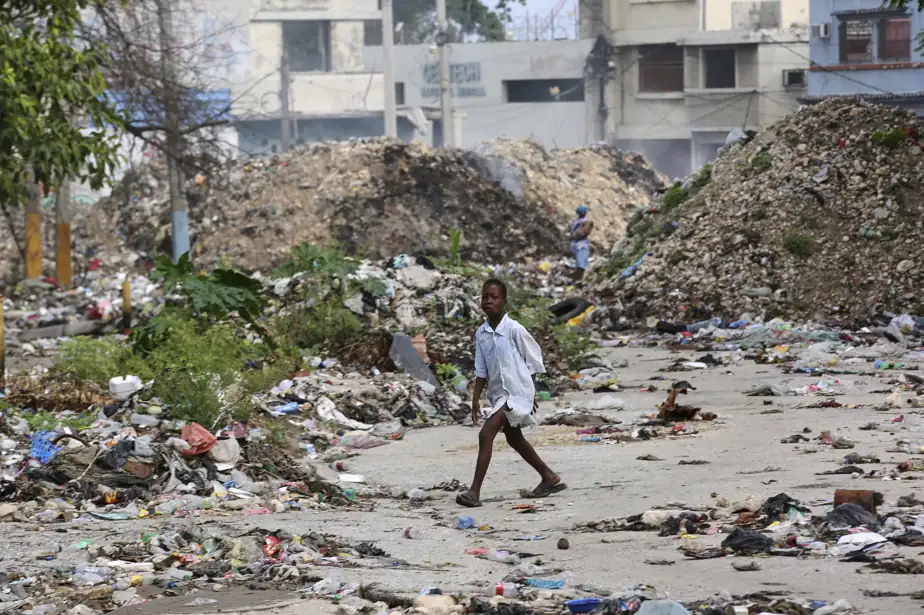
Armed gangs have taken control of almost all of Haiti’s capital Port-au-Prince in a conflict that has forced some 1.3 million people from their homes, and fueled famine-level hunger.

At an event organized by the U.S. and Kenya on the sidelines of the annual U.N. gathering of world leaders, Ruto said the 15-month-old force – known as the Multinational Security Support mission – had been operating at only 40% of the expected strength of 2,500 security personnel.

The U.N. Security Council mandate for the MSS mission is due to expire on October 2. A Security Council resolution requires at least nine of the 15 votes in favor and no vetoes by the U.S., Britain, China, France or Russia.

« I must commend the United States. They did make available logistics and vehicles. But unfortunately, most of the vehicles were second-hand vehicles, and therefore they broke down a lot, many times. And in fact, it put our personnel in great danger when they broke down in very dangerous places, » Ruto said.

« But at least they stepped up, » he added. « We didn’t however get any useful support from any other quarter. »

The United States and Panama last month put forward a draft resolution to transition the existing 15-month-old MSS mission into a new larger Gang Suppression Force supported by a new U.N. field office.

The proposed new force would still rely on voluntary international contributions of personnel and funding, but the leadership structure would be different. It would be led by a group of representatives from countries that have contributed personnel, plus the United States and Canada.

HAITI AT CROSSROADS

The proposal follows a U.S.-led push last year to convert the Kenyan-led mission into a formal U.N. peacekeeping force to bolster its resources, which was opposed by Russia and China.

« Haiti stands at a crossroads. Port-au-Prince faces an escalating security crisis with gangs terrorizing communities, extorting families and recruiting desperate children to commit horrors on behalf of gang leaders, » said U.S. Deputy Secretary of State Christopher Landau, who also announced the U.S. was sanctioning two former Haitian officials.

He said the MSS lacks « the mandate and the resources necessary to address the mounting scale of the challenge » in Haiti.

China’s deputy U.N. Ambassador Geng Shuang said Beijing supports the mission in Haiti continuing to play « its significant role and stands ready to engage with all parties to explore all possible, and also feasible, ways forward. » He also said Haiti needs to « ownership and assume primary responsibility by taking concrete actions. »

Laurent Saint-Cyr, president of Haiti’s Transitional Presidential Council, told the event on Monday that the security situation in the country « remains the main obstacle to finalizing our objective – ensuring a peaceful transition to power through elections. » Haiti supports the creation of a new gang suppression force, he said.

Ruto said Kenya was ready to participate in any new mission, but warned: « If we don’t correct the mistakes of the past, we will, most unlikely succeed. »
Share post:

Les + Populaires

Plus d'Articles
Similaires

Haïti : élections, sécurité, sanctions et Global Gateway: Hélène Roos répond à 15 questions sur l’action de l’Équipe Europe

"De notre côté, comme partenaire, nous prenons nos responsabilités : l’Union européenne dispose d’un régime de mesures restrictives à l’encontre de personnes et d’entités considérées comme responsables d’actions menaçant la paix, la stabilité, ou la sécurité d’Haïti, ou portant atteinte à la démocratie et à l’État de droit. Ce régime n’est pas un instrument électoral et les sanctions européennes ne constituent pas, en elles-mêmes, des critères d’éligibilité au regard du droit haïtien. Elles consistent en revanche en une liste de personnes qui sont interdites d’entrée sur le territoire de l’Union européenne, soit dans ses 27 États membres, ainsi qu’en la possibilité degels d’avoirs. "...

Haïti : le Conseil de sécurité de l’ONU examine lundi la situation sécuritaire et les préparatifs électoraux

Le Conseil de sécurité des Nations unies tiendra lundi 19 octobre une séance publique consacrée à Haïti, suivie de consultations à huis clos, avec au programme la dégradation de la situation sécuritaire, le déploiement de la Force de répression des gangs (GSF) et les incertitudes entourant l’organisation des prochaines élections. Selon Security Council Report, publié le 16 octobre, trois responsables onusiens sont susceptibles de présenter un état des lieux : Carlos Ruiz Massieu, représentant spécial du secrétaire général et chef du Bureau intégré des Nations unies en Haïti (BINUH) ; Jack Christofides, représentant spécial pour la GSF ; et Daniela Kroslak, secrétaire générale adjointe et cheffe du Bureau de soutien des Nations unies en Haïti (UNSOH), dont la participation au briefing reste possible.

Martelly puts elections rumors to rest, registers to run for Haiti presidency

Former Haitian President Michel Martelly has registered to run for the presidency of the Caribbean nation, joining a growing list of candidates hoping to lead a troubled Haiti despite facing sanctions from the United States, Canada and the European Union — or in the case of the former singer, all three. Martelly’s name was among 16 listed Friday on the Provisional Electoral Council’s website as having preliminary registered to run. The list also includes another former president, Jocelerme Privert, and a former member of the lower house of Parliament, Gary Bodeau. Privert who oversaw the country’s last general elections in 2016, has been sanctioned by Canada. Bodeau has been sanctioned by the U.S. Treasury Department under a federal act that targets perpetrators of serious human rights abuse and corruption, and faces Canadian sanctions as well.

Exclusive: Inside Erik Prince’s secretive operation taking on Haiti’s gangs (CNN)

Prince would not disclose the annual fee he receives for work with the Task Force, claiming only that it is a “fraction” of the cost of the short-lived Multinational Security Support mission — an initiative backed financially and logistically by the United States, that once envisaged 5,500 foreign police in Port-au-Prince. “Our cost is one-sixth of what their annual camp cost was,” Prince said. The sum is likely in the tens of millions of dollars. His income will be augmented by a deal to help control Haiti’s porous border with the Dominican Republic for the next 10 years in return for 10% of any new customs revenue collected. The long-term contract has raised criticism locally of how Prime Minister Alix Didier Fils-Aimé is using his mandate as interim leader.