

Haiti’s first Winter Paralympian shared his journey from losing a leg in the 2010 earthquake to racing in Para Alpine skiing.
Ralf Etienne is succinct in the telling of his life story « in a nutshell » to Olympics.com ahead of competing in men’s Para Alpine skiing standing giant slalom on Friday (13 March) at the Milano Cortina 2026 Paralympic Winter Games.
« Born and raised in Haiti, I lost my leg in the 2010 earthquake in Haiti 16 years ago, so it’s really from the rubble to the summit of the Alps, skiing at the Paralympics with the most elite Para skiers in the world. It’s just unbelievable. »
Well, quite.
There’s a lot to unpack here, not least the fact that the 36-year-old is the first ever Winter Paralympian to represent his beloved Haiti.
« I’m still processing what it’s meant to be here, but it’s a great platform for my country, to show a different face of my country. When people see Haiti, they see chaos, so I want to show them excellence, leadership, resilience, hard work. »
The four characteristics listed by the Miragoâne-born Para Alpine skier couldn’t be more representative of the man himself.
Resilience was required in the immediacy of the life-changing moment when the businessman was buried upside down in a multi-storey building, which collapsed after the earthquake hit the Caribbean nation.
Etienne was rescued after almost eight hours, lucky to emerge when more than 300,000 people died in the disaster.
Not surprisingly, the experience, not least the amputation of his left leg, changed him.
« I was a very successful entrepreneur in Haiti when the earthquake happened, » Etienne told Olympics.com in the Paralympic Village in Cortina d’Ampezzo. « It changed my life around, so I pivoted from for-profit business to more social enterprise, non-profit for a while, and then I went to the US for college.
« I returned to Haiti. I did full-time non- profit and impact investment for four years, and then I returned to the US again to get my MBA so I can do more impact investment, » said Etienne of the hard work embarked upon to help his country the best way he knew how.
Over the past 16 years, Etienne has used his business skills to help rebuild homes and support health care, including distributing 40,000 pairs of glasses as part of an effort to improve eyesight, to help his nation re-emerge from the disaster.
A return to banking saw Etienne spend three years in New York before moving to London six months ago to be closer to the Alps to train and race. After all, qualifying for the Milano Cortina 2026 global showcase would be another way Etienne could help his nation make its mark on the world.
Haiti Paralympic skier Ralf Etienne: “Everything is possible!”
The 36-year-old Para Alpine skier, who lost his left leg in the 2010 earthquake that struck his island, hopes to inspire young people in his country by showing them that anything is possible through hard work…_Read More
Haiti’s first Winter Paralympian Ralf Etienne
« Being the first Winter Paralympian from Haiti is cool but it’s not easy, » said Etienne, who was aided by a 12-month grant from the International Paralympic Committee’s Sport for Mobility programme to help qualify for the Games.
« It’s a lot of work. It is a lot of sacrifice, but here I am. I made it to the Paralympics. »
It’s also a lot of pressure to be the sole representative of your country in one of life’s greatest displays of human endeavour.
« I’m literally an ambassador for Haiti, so everything I do matters because it shows what Haiti is capable of. It’s a lot of pressure.
« I like to be humble, but I have to show the perfection, I have to show the elitism of Haiti. I have to train harder because when I go on the slope… it doesn’t matter what number I’m at, I want people to say this guy was skiing really well. »
Etienne has already demonstrated excellence, not in any expected medals, but in how he conducts himself, he said, after being asked what he expected from his time in Italy.
« I expect to get a chance to keep highlighting Haiti by skiing really well, by being a good teammate and a good co-athlete to everyone, and just do a good job and contribute to the beauty of the Paralympic Games. »
A leadership role has also naturally emerged with Etienne aiming to inspire the next generation of Haitian athletes.
« I want, also, to show the youth in my country that there is hope, because I’m from Haiti, I am disabled, I can be here, so they can do anything they want to do.
« Everything is possible if you focus. If you work hard and you pray harder, everything is possible. »
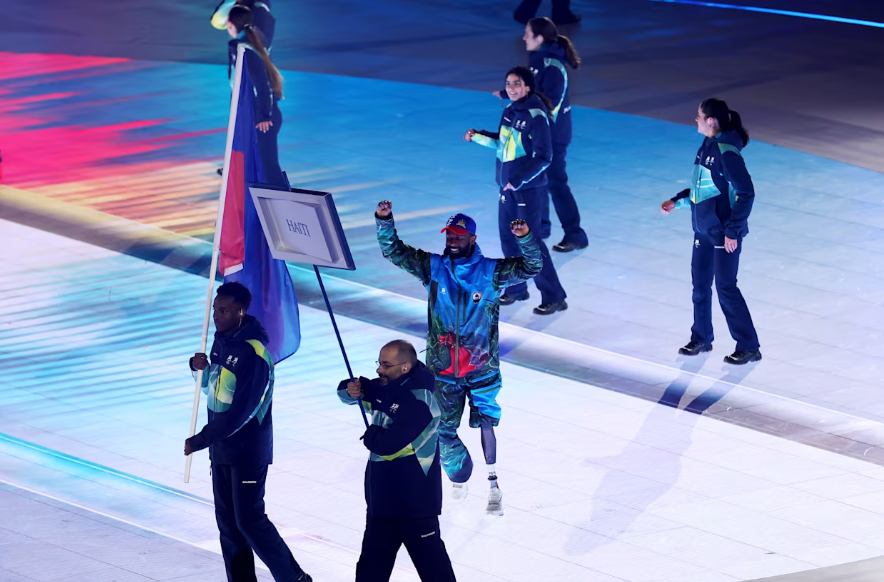
Volunteer Flagbearers of Team Haiti walk through the stadium with Ralf Etienne of Team Haiti during the Milano Cortina 2026 Winter Paralympic Games opening ceremony