

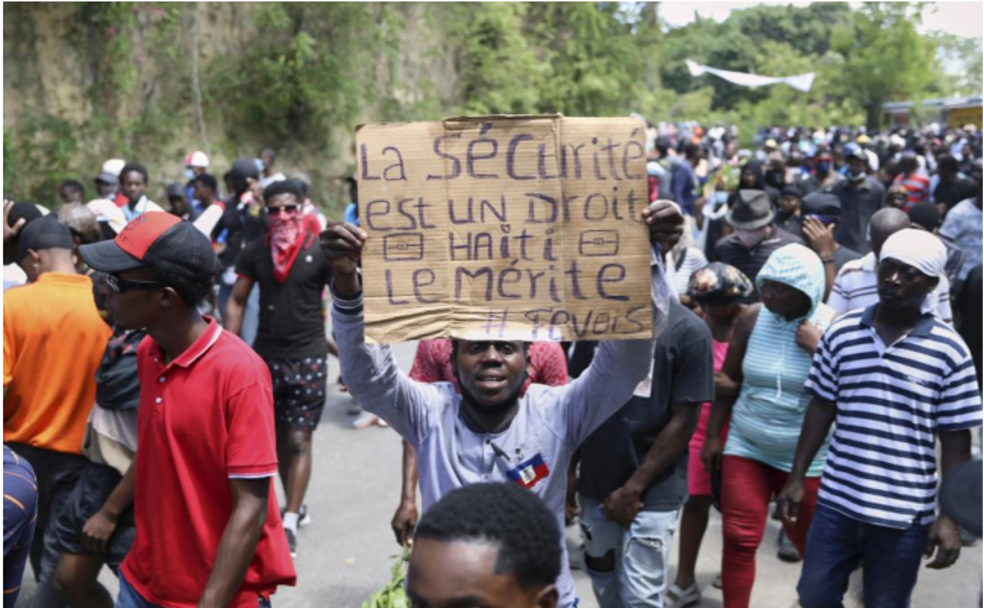
Haiti is experiencing one of the worst crises in its recent history: armed gangs control much of the capital, institutions are paralyzed, and the population is suffering from systemic violence and famine.
The presented article analyzes the evolution of Haiti’s criminal governance and outlines three forecast scenarios for the period 2025-2030: stabilization, stagnation, and further state collapse. The final reflection underlines the geopolitical implications for the Caribbean and the US, highlighting how Haiti’s future represents a crucial challenge for regional security and for the international community’s ability to address criminal governance phenomenon in contexts of state fragility.
CORPUS
Over the last two decades, organized crime in Latin America has undergone a profound transformation, revealing a complex nexus between illicit networks, political authority, and external geopolitical actors. Despite the absence of conventional warfare, the region faces extremely high homicide rates, which reflect the condition of chronic violence embedded within democratic governance, producing hybrid political orders. While Mexico, Colombia, and Brazil each display different patterns of this dynamic,they collectively show how criminal actors have become central agents of governance and insecurity. Haiti, however, now represents the most extreme manifestation of this continental pattern.
After the assassination of President Jovenel Moïse in 2021, gang proliferation broke new ground, with over 250 groups active by 2025, diversifying Haiti’s criminal ecosystem. Since then, Haiti has entered a new and more dangerous phase of state failure. The country no longer faces temporary instability but a complete breakdown of political authority. No functional government or parliament has been in place for years, and the justice system is almost entirely paralyzed. The Haitian National Police is understaffed, and underequipped.
As a result, gangs have become the main power brokers in the country, openly controlling neighborhoods, ports, and key supply routes. Criminal groups exploited crises, such as Covid-19 pandemic, chronic fuel shortages, and natural disasters, by controlling humanitarian aid distribution and imposing informal taxation, further entrenching themselves as alternative providers of governance. In Port-au-Prince, armed groups dictate who can move, trade, or access to basic goods. By mid-2025, they controlled nearly 90% of the capital, displacing over one million people and precipitating the collapse of Ariel Henry’s government, effectively replacing the state in many areas. This shift marks a radical alteration of Haitian status quo: violence is not simply a symptom of collapse, but the basis of a possible new political order.

Haitian gangs have evolved over time, from fragmented street groups into structured organizations with possible political ambitions. Among the most prominent groups, we have the G9 an Fanmi e Alye, led by ex-police officer Jimmy “Barbecue” Chérizier, which operates as a federated militia embedded in national politics. Another major actor, 400 Mawozo, becomes a dominant frontier-broker leveraging cross-border smuggling and kidnappings. Meanwhile 5 Segonn/Canaan coalition has turned coastal zones into strategic hubs for weapons imports and maritime taxation.
These groups function as proto-states. They collect taxes from residents and businesses, and even manage aid distribution, and the violence they display is strategic and political, aimed at territorial control and resource extraction rather than individual disputes. Their consolidation demonstrates how Haitian gangs no longer just fill a governance vacuum but actively reshape political, territorial, and economic orders. This level of control represents a new form of governance based on coercion, fear, and clientelism.
Economically, Haiti has suffered six consecutive years of contraction, with GDP falling 4.2 % in 2024 and 3.1% in 2025 and inflation remaining above 25%. Severe food insecurity affects nearly 5.7 million people, and nearly half of Port-au-Prince’s population has been displaced. In many cases gangs control the flow of humanitarian assistance, reinforcing their local influence and undermining what remains of government authority. Criminal control of ports and fuel depots has also worsened the crisis. Gangs frequently block shipment, impose taxes on goods, or seize aid convoys, with the intent to consolidate political leverage and territorial dominance.
The 2024 Multinational Security Support Mission (MSS), led by Kenya and backed by the U.S., was not as successful as expected. The mission’s mandate focused on restoring order and supporting the Haitian National Police (HNP), but it faced serious operational and legitimacy challenges. It was structured as a military operation, regardless of the needs of civilians living under such conditions, nor a secure plan on how to restore the justice and educational systems. Moreover, the mission never reached its target strength of 2.500 troops, and its annual budget was never met. In many ways, it was destined to fail.
In September, a new resolution, backed by the U.S. and Panama, was approved to establish the Gang Suppression Force (GSF), a 5.500-men contingent to confront gangs directly rather than only supporting the HNP. The GSF seeks to correct the MSS failures: it has a clear and forceful mandate to directly target gangs and their networks, with the authority to act independently of the HNP. A new UN Support Office and a Standing Group of Partners (including U.S. and Canada) will oversee strategy and coordination. However, no country has yet promised troops, and Washington insists it will not send U.S. soldiers, but only funding and logistical support. This mission might represent Haiti’s last opportunity to restore order, but its success will depend on both international commitment and the country’s fragile political situation.
FUTURE SCENARIOS
- Best case scenario: : stabilization
The international intervention succeed in creating a new Gang Suppression Force (GSF) which obtains sufficient financial and personnel support, and gradually stabilizes the situation, allowing the Haitian state to regain part of its monopoly on force and governance. The country will then be able to hold elections within a reasonable timeframe, and with legitimacy at least partially accepted by the public. A credible process of reforming the police, the judiciary and state institutions would also be initiated. As a result, gangs would gradually lose control over key territories or enter coexistence-agreements, leading to a decrease in homicides, kidnappings and extortion rates. This scenario would foresee the reopening of public services, such as schools and hospitals, improving humanitarian access and international engagement. Moreover, the economy would begin to slowly recover.
However, there are three major risks we need to consider: gangs would not be fully dismantled but only weakened, which may mean they could potentially regenerate in the future; the country would still be dependent on external support, and if this latter wanes, the situation could relapse; state reforms may progress slowly, with limited capacity to reach peripheral areas.
- Most likely scenario: stagnation
Scenario that it seems to be the most plausible, with the state unable to fully regain its authority, while gangs continue to play a strong role. Instability becomes normalized.
The GSF’s intervention is revealed to be inadequate, insufficiently funded and poorly coordinated, or just partially effective. Elections are held but with low turnout, and the process is marked by pressure and intimidation. State institutions improve marginally but remain understaffed and underfunded.
Gangs are not completely suppressed, instead they become political/informal actors, negotiating in part with the state or with international actors.
As a result, we might expect a division between those urban areas that return to be relatively safe, and those which remain under criminal control, where gangs continue to manage extortion, informal taxation, etc. Moreover, the state remains fragile, and humanitarian conditions persist: displacement, insecurity, and poverty show very little improvement.
This scenario highlights a stagnation transition, where the state functions partially, and gangs become part of the power system. The country remains vulnerable to shocks that could trigger another collapse.
- Worst case scenario: further state collapse
In this case, the international intervention fails or withdraws prematurely, and the Haitian state loses its remaining institutional and territorial control. The GSF proves to be unable to contain the violence, while armed groups expand their influence even more, reaching provincial towns and strategic routes, including border areas with the Dominican Republic.
Widespread violence, kidnappings, and displacement escalate, leading to a deteriorating humanitarian crisis and mass migration towards neighbouring countries and the U.S.
The economy collapses, while illicit trafficking flourishes. Haiti risks entering a state in which non-state actors completely replace the state’s authority, resulting in a criminal fragmentation of the country.
GEOPOLITICAL IMPLICATIONS
The Haitian situation not only has significant local implications, but also on a regional and global level due to its interconnected dynamics between criminal groups, fragile governance, and external interests. If the Haitian state continues to lose control over its territory and violence, it may become a strategic point for illegal flows (weapons, drugs, and human trafficking), which are already present within the country but at a lower rate. However, if the situation keeps deteriorating, these illegal activities could cross international borders, making the crisis a security issue for its neighbours as well.
Moreover, since the government in the region has proven to be unable to provide services forcing people to relocate, gangs have begun to use the strategy of “displacement weaponization” i.e., forcing populations to flee in order to strengthen their territorial control as the vacuum left by the state becomes an opportunity for criminal occupation. These dynamics produce instability that can transcend the Haitian context and exert pressure on neighbouring countries.
In other words, what we are witnessing in Port-au-Prince and in the surrounding areas will not remain confined, quite the opposite, it will translate into a direct threat to the stability of the Caribbean and the U.S., in terms of migration, border security, and public order.
the economic and infrastructural dimension cannot be overlooked as well.
Haiti, due to its geographical position, serves as a gateway for maritime and land trafficking between the Caribbean, Central America and the U.S.. The fact that gangs now control critical areas of the territory and infrastructure creates a domino effect on the regional logistics chain and legal economies. The more these routes become militarized or criminalized, the greater the risk that the region will become a strategic hub for transnational illegal economy, where economic and political power shifts from public institutions to criminal networks.
CONCLUSION
To conclude, the Haitian crisis represents one of the most urgent and complex challenges that the international community is facing nowadays. The level of violence, the absence of a stable government, and the strength of the gangs make the country an extreme case of state collapse, but not completely without hope. Haiti has already demonstrated extraordinary resilience in its past history, and it is precisely this resilience that can be the basis for a new beginning. However, ignoring the situation or considering it a distant problem would mean leaving room for inevitable deterioration, with direct effects on neighbouring countries, and in the long term, on regional and international security.
This is where international intervention must play a fundamental role, but with balance and sensitivity. It cannot be presented as an external imposition, nor can it repeat the mistakes of the past: experience such as that of MINUSTAH have shown that a top-down approach, too rigid and non-inclusive of the population, ends up undermining the trust and credibility of the institutions themselves.
On the contrary, any attempt at lasting stabilization must start by listening to local communities, valuing the testimonies of those experiencing this crisis on a daily basis, and seeking inspiration from other Latin American experiences of reintegration and pacification.
Ultimately, Haiti’s future will depend on its ability to combine security, inclusion, and development. Not an easy task, but ignoring the issue would be a drastic mistake.