
By Christopher Sabatini, the senior research fellow for Latin America at Chatham House, and Robert Greenhill, the executive chairman at Global Canada, a Montreal-based think tank.
The Trump administration’s U.N. resolution reimagines international responses to humanitarian crises.
Those suffering in humanitarian crises around the world, from Sudan to Haiti, are also victims of an international system that has broken down. The United States is retreating from international cooperation; geopolitical competition has put the great powers at loggerheads in multilateral bodies; and the mechanisms, procedures, and lessons developed by peacekeeping missions since 1948 are being bypassed or otherwise ignored.
There are plenty of instances in recent history of multilateralism helping to rally international attention and action, even if temporarily, to alleviate human suffering. Think of Sierra Leone, Liberia, Colombia, Guatemala, and El Salvador post-civil war.
But organizations such as the United Nations, the Organization of American States (OAS), and the African Union have not always succeeded in their broader missions of rebuilding states, resolving centuries’ old conflicts, or addressing the corrosive effects of illicit activity and corruption.
Haiti is one of those cases of past failures, but it may now offer a model path out of international paralysis over humanitarian crises and conflicts. While the contours and funding of September’s U.N. Security Council resolution on Haiti are still to be defined, the approval of the resolution was itself a significant milestone—China and Russia, quietly aligning themselves with the demands of the Global South, held their vetoes to allow the U.S.-sponsored resolution to move forward. With the support of Panama, the Trump administration’s initiative demonstrated leadership in embracing new multilateral solutions to humanitarian crises.
The era when peacekeeping countries could depend on U.S leadership and funding to combat soft development needs at the root of conflict and state breakdown has ended, possibly permanently. Haiti will be the first test of a more ad hoc, dispersed form of leadership and diplomacy.
The July 2021 assassination of Haitian President Jovenel Moïse plunged Haiti into a governance and security crisis. Since then, the country has had no elected president or legislature. Executive power is exercised by an unelected Transitional Presidential Council, intended at the time of its establishment in April 2024 to restore security and organize overdue elections. But the council inherited an eroded state apparatus and limited territorial control, and it has failed to meet many of its goals, including the creation of new criminal and anti-corruption courts.
The vacuum of governance and government legitimacy accelerated the collapse of security in the country. Armed gangs and militias now control large areas of key transport corridors and the capital city, Port-au-Prince—using kidnappings, extortion, and targeted killings as tools of predation and political leverage.
At the OAS General Assembly this June, U.S. Undersecretary of State Christopher Landau challenged the Western Hemisphere’s premier multilateral body to come up with a response to the crisis. His not-so-subtle threat was that if the OAS couldn’t solve the Haiti problem, then it didn’t deserve U.S. funding—which represents 60 percent of the body’s budget.
Two months later, in August, the OAS produced a jargon-laden roadmap toward peace in Haiti. The document was long on development-speak and short on specifics, with barely a mention of the White House’s primary priority: Insecurity caused by criminal gangs. The United States ignored the OAS’s eyewatering $2.6 billion proposed budget and instead turned to sponsoring a U.N. resolution.
The resulting resolution, approved by the U.N. Security Council on Sept. 30, establishes a Gang Suppression Force in Haiti and will require voluntary contributions to pay for troops. While it will not draw on U.N. member dues or deploy the U.N. blue helmet forces that typically support peacekeeping missions, the logistical and operational work of the mission will be supported by U.N. funds. The deployment of additional international troops in-country, as well as traditional development programs, will draw on voluntary contributions.
With the dissolution of the U.S. Agency for Development (USAID), the question has become: Who will step up to support programs critical to the long-term success of reducing global crime and insecurity—programs that, for example, target restoration of public health and education services and promote economic growth?
U.S. leadership on this front has traditionally taken the form of working the halls of multilateral organizations and embassies for collective responses, rallying U.N. and OAS member states to the cause, coordinating donor conferences, and leveraging its contributions for other governments to cough up their own. Many of those roles will become secondary as the Trump administration focuses on specific and much-needed security-focused priorities over development.
Instead of development assistance or boots on the ground to contribute to the security forces in Haiti, the United States is offering technical, logistical, and material support. The security-heavy focus, without the institutional and developmental assistance to ensure security over the long term, risks alienating some potential supporting governments. This is where the responsibility falls on states such as Brazil, Canada, and European Union member countries to define, fund, and organize Haiti’s non-security related needs.
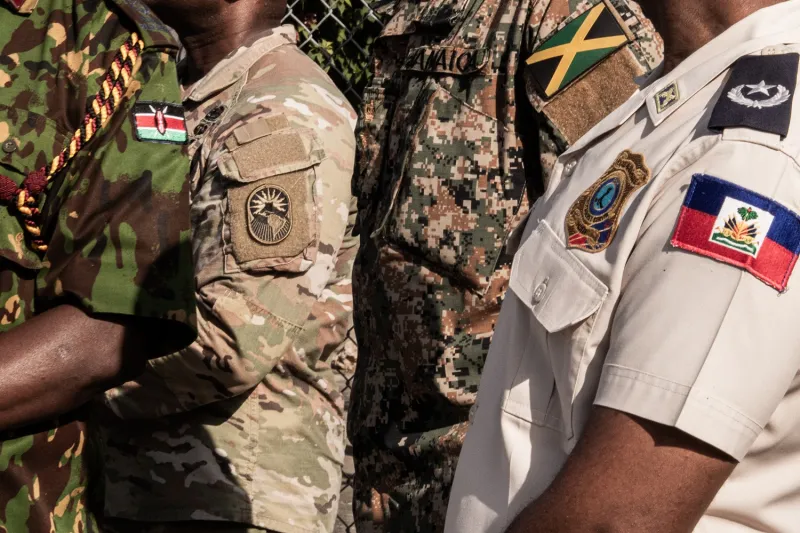
The resolution on Haiti now faces two challenges. The first is coming up with the voluntary contributions required so that it doesn’t meet the same fate as the Gang Suppression Force’s predecessor. That was the Multinational Security Support Mission, approved by the Security Council in October 2023, which fell far short of its goals. Originally intended to incentivize U.N. member governments to cough up $600 million in contributions and deploy 2,500 international police and security officers to Haiti, the mission generated only a fraction of the hoped-for contributions, and just 800 or so Kenyan police officers responded to the call for security forces.
The second challenge is establishing a credible transition government in Haiti to receive and manage the new U.N. mandate and all the necessary reforms. The current Transitional Presidential Council’s mandate, negotiated by the Caribbean Community in 2024, expires on Feb. 7, 2026. The council was to be replaced in a late 2025 election, but with gangs controlling the capital and expanding their presence to rural areas and more than 1.5 million people displaced, Haiti is in no condition to meet the deadline. At the same time, there is little appetite to extend the council’s rule indefinitely, and gangs have threatened disorder if the councile attempts to stay in power.
Fortunately, there is a broad civil society movement, the National Patriotic Congress, that is bringing together Haitian voices. Should it succeed in its goals and stay above the partisan fray, the Patriotic Congress can play a novel role in creating a credible, inclusive, Haitian-led counterpart to international efforts, bypassing the country’s venal political class.
So why is there reason to believe to this new call for an ad hoc multilateral response to the crisis in Haiti can be successful? First, at a mobilization meeting held in New York this month, countries ranging from Bangladesh, to Burkina Faso, Chad, Gambia, and Sierra Leone pledged security forces to add to Kenya’s existing forces. (It is notable that many of the voluntary contributions so far have come from the Global South.) If realized, the pledges will meet the needed force of 5,500 security officers in Haiti.
The next step will be ensuring that other governments contribute the necessary funds, to support not just the security initiative but development efforts as well. Canada’s $60 million contribution back in September, on the eve of the Security Council vote was an important initial step. If other countries rise to the occasion, the Haiti response could become a role model for international intervention.
Today, if Haiti and its champions went, cap in hand, to a funding conference with a “business as usual” approach, they would likely be seriously disappointed. Let’s face it: USAID is gone, international aid is scarce, and “Haiti fatigue” is real.
But in a paradoxical way, Haiti’s deep crisis has created a fleeting but real moment of opportunity for both itself and the multilateral system. The dangers of total collapse are so great that its own leadership and the international community have woken to the need for radical action.
The U.N. resolution could be a reimagination of international response to humanitarian crises, with the global community stepping up with financial, material, and personnel contributions (including from the Global South) when traditional multilateral responses fail. Provided it works, the the Gang Suppression Force may serve as a model beyond Haiti, to crises in areas such as Sudan and the Democratic Republic of Congo.
It is noteworthy and inspiring that countries such as Sierra Leone, Burkina Faso and Gambia have gotten involved with security force contributions. Now it’s up to the developed world to meet those countries’ personnel commitments with funding. In the balance hangs not just Haitian lives and the security of the broader Caribbean, but the future of a new multilateral system.