

Haiti’s armed gangs are increasingly expanding from Port-au-Prince into rural areas, adopting hit-and-run tactics including kidnappings, cattle theft and roadblocks while security and political responses remain focused on the capital, a new report said on Monday.
The analysis, published by the Global Initiative Against Transnational Organized Crime’s Haiti Observatory, said the shift amounts to more than an extension of urban gang activity into the countryside.
- Gangs are using small, mobile units to carry out rapid raids, harass communities and move between areas serving as sanctuaries and targets, the report said. The approach allows armed groups to project influence and disrupt daily life without permanently occupying territory.
- The report cited the recent attack on Kenscoff, a mountainous community outside Port-au-Prince, as an example of the changing nature of gang violence. The assault killed dozens of people and involved a mass kidnapping, it said.
- It also highlighted worsening insecurity in Artibonite, one of Haiti’s main agricultural regions, where gangs have targeted communities, transport routes and farmland.
- The growing violence in rural areas poses a challenge for Haitian security forces, which the report said lack the personnel, equipment and training needed to counter highly mobile armed groups across mountainous and dispersed terrain.
- The report said a security response alone would be insufficient, calling for measures to protect farmers, restore local economies and address long-running land and community disputes, alongside efforts to disarm and reintegrate gang members.
On 23 August, after weeks of planning, armed men attacked the rural community of Kenscoff, outside the Haitian capital of Port-au-Prince. The assault left at least 47 people dead and culminated in one of the largest mass kidnappings in the country’s history.
The attack highlighted a long-standing issue: despite the reinforcement of Haitian security forces, criminal groups still retain the capacity to attack at will. It also reflects a broader shift in the country’s crisis, one that has so far received insufficient policy attention.
Since February 2024, when Haiti’s principal gangs joined forces under the Viv Ansanm coalition, security efforts have remained focused almost entirely on Port-au-Prince, while gang violence has increasingly become rural and centrifugal, extending far beyond the capital. The gangs’ expansion has been enabled by a structural weakness in the response: forces lack the numbers, training and equipment to confront dispersed, highly mobile armed actors across rural and mountainous terrain.
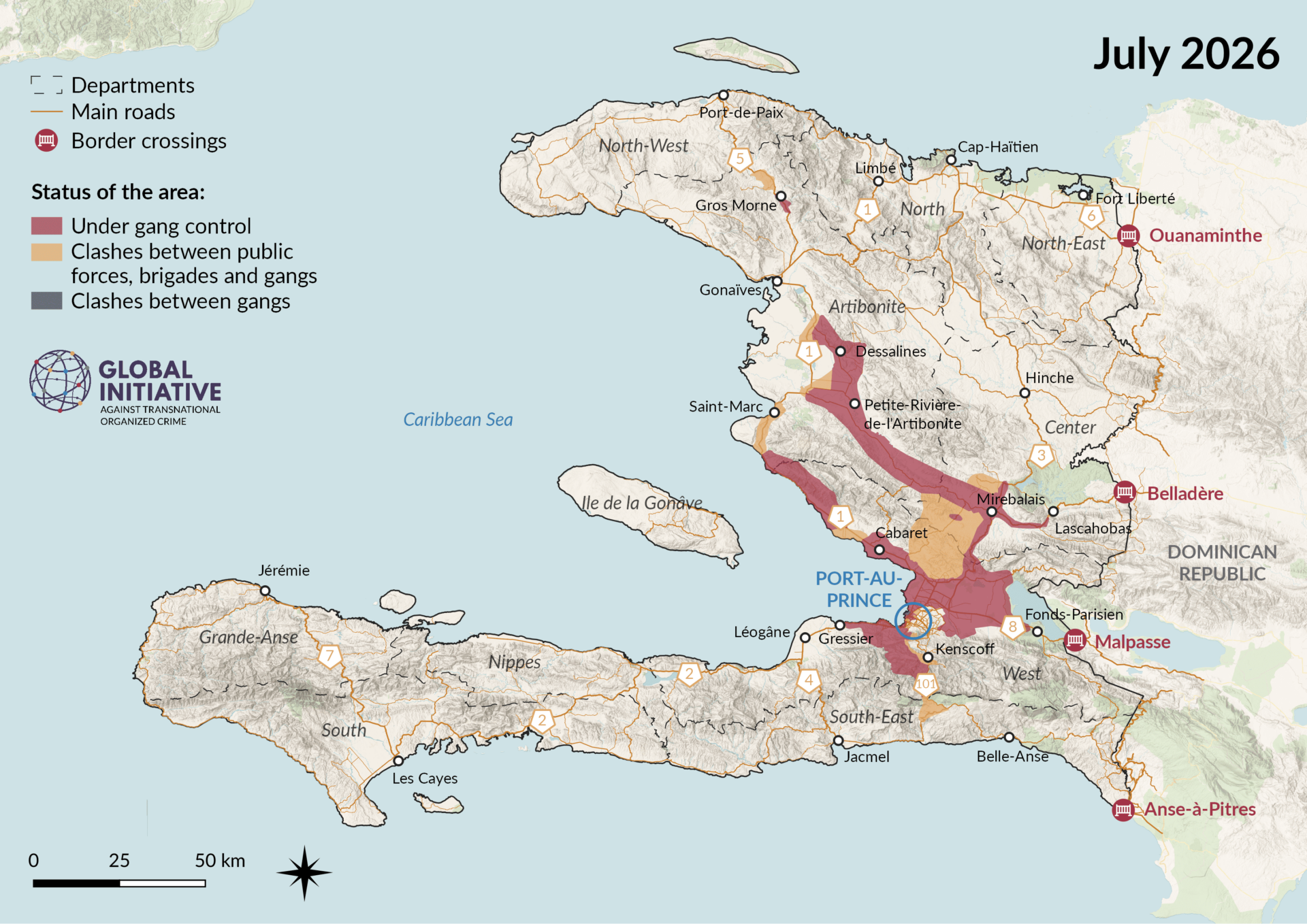
Two case studies in rural gang expansion
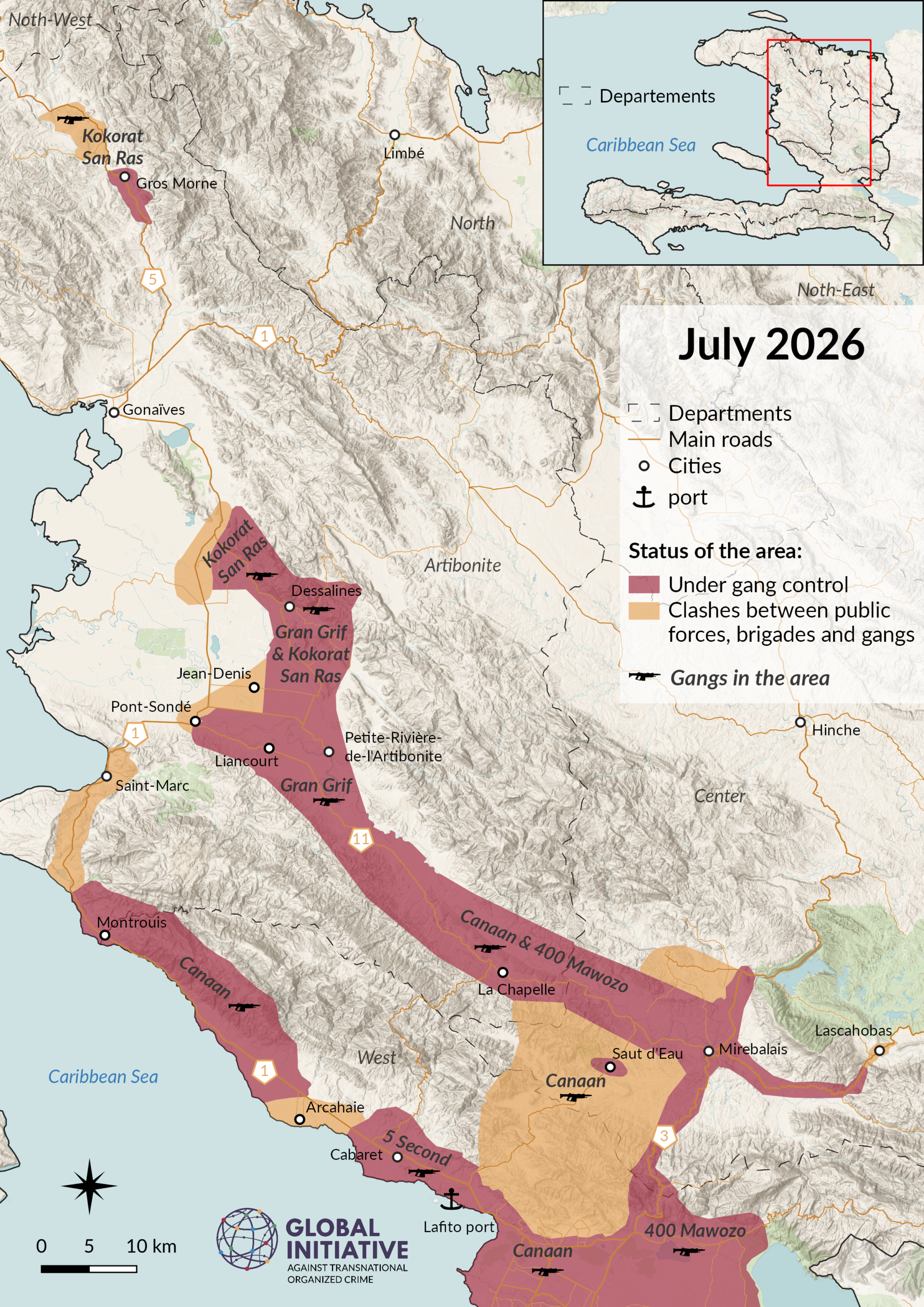
Since 2024, the Artibonite department, north of Port-au-Prince and home to much of Haiti’s agricultural production, has become one of the country’s most volatile conflict zones. The violence is perpetrated both by local criminal groups, mainly Gran Grif and Kokorat San Ras, which announced an alliance in April 2026, and gangs from the capital, particularly the Taliban and 5 Segond. In 2025, 456 people were killed in the region, accounting for 16% of all victims nationwide, and tens of thousands were displaced. These levels of violence have continued into 2026.
The latest massacre in Artibonite occurred at the end of March, when Gran Grif attacked Petite Rivière and Dessalines, killing over 70 people and displacing more than 13 500. Advance warnings had circulated on WhatsApp, and the operation was meticulously planned. Roads and bridges were blocked, preventing law enforcement and self-defence brigades from intervening and limiting residents’ ability to escape. Homes were set alight with occupants trapped inside. Those attempting to flee were shot. The massacre was followed by territorial expansion, and Gran Grif and Kokorat San Ras now control vast portions of the Artibonite’s fertile lands and key roads.
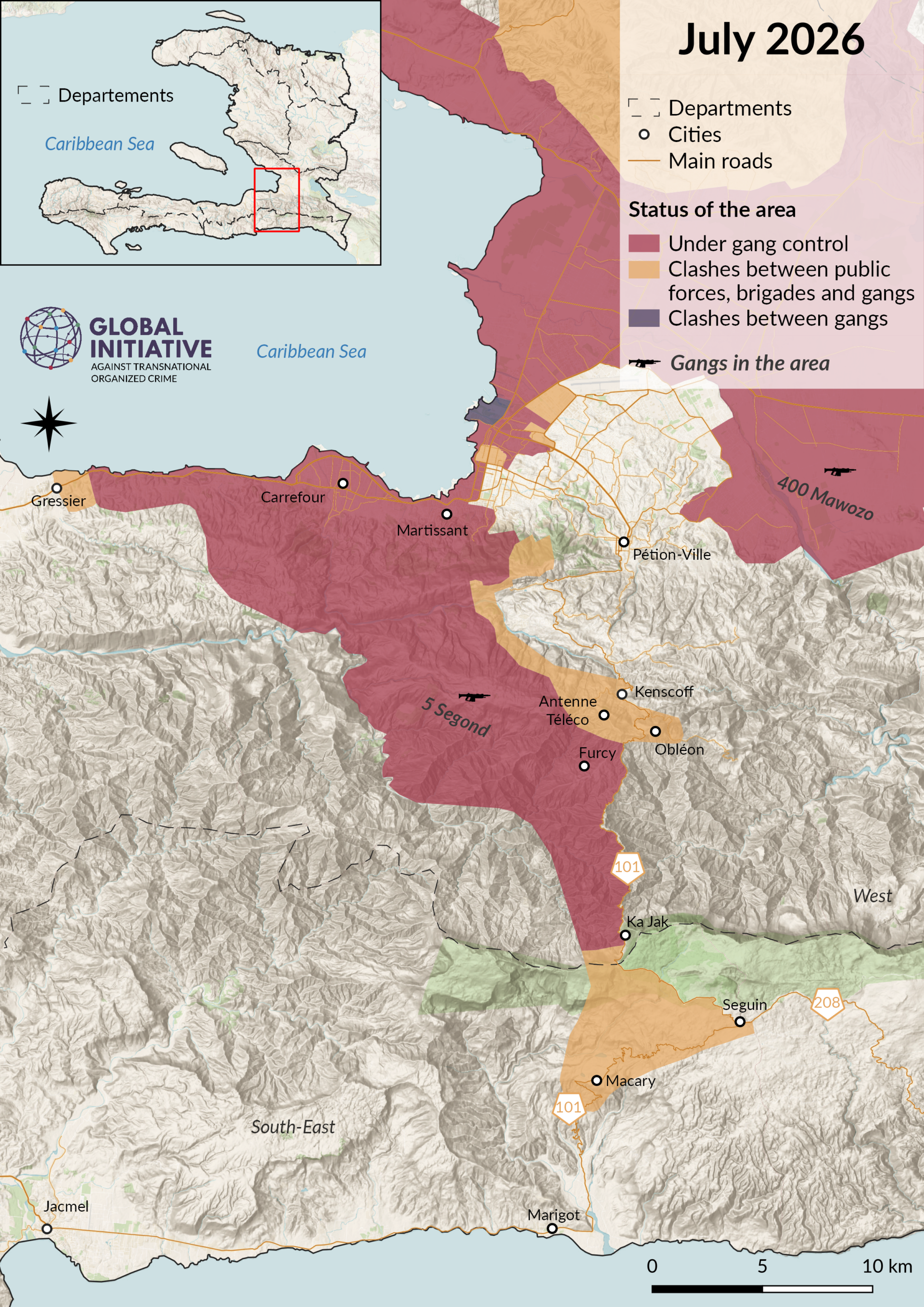
The mountainous commune of Kenscoff, which overlooks the Port-au-Prince metropolitan area, was invaded by gangs from the capital in January 2025. Over time, a group led by an individual known as ‘Didi’ or ‘Izo 2’ has become familiar with the terrain, giving them a tactical advantage in operations launched from ravines and high ground. They maintain dispersed cells of roughly a dozen men, capable of acting at short notice. While security forces hold fixed positions in the town centre, the criminal groups move around them, harassing isolated communities, blocking roads and increasing their territorial hold.
Between 4 and 9 July, the gang stormed the locality of Robin, killing between 61 and 105 people. They raped civilians in their homes and forced almost 6 000 people – nearly a tenth of the commune’s population – to flee. Six weeks later, on 23 August, the gang targeted the centre of Kenscoff. Preparations for the operation included the use of drones for reconnaissance. Starting at about 9 p.m., gang members struck a displacement camp inside a church, set fire to houses and killed dozens of civilians just metres from the police station. At least 50 people were kidnapped. In a video posted on social media, Didi threatened to execute the hostages, including the children, if security forces hit back, saying: ‘If any of our soldiers are hurt, I will kill all of them.’
Criminal governance and guerrilla tactics in rural Haiti
The ruralization of Haitian gangs represents more than the extension of urban criminal practices to backcountry areas. It has prompted these groups to adopt new operational strategies that go beyond the invasion of territory, and has enhanced their capacity for criminal governance. Guerrilla-type tactics such as lightning raids, harassment, looting, cattle theft, rape and kidnapping are common, alongside rapid movement between sanctuary zones and areas of attack.
Hostages can also serve as a substitute for large-scale territorial occupation. While fixed positions require personnel and resources, and are vulnerable to attack, holding captives requires far less operational investment, while providing leverage for ransom negotiations. Furthermore, public threats, such as those made by Didi on 23 August, are designed to put the authorities in a no-win situation: inaction would demonstrate the state’s inability to protect its population, whereas intervention could enable the gang to blame the police for any subsequent fatalities.
The situation in Artibonite and Kenscoff therefore shows that Haiti’s gangs do not necessarily need to fully occupy an area to increase their influence. Even if gangs are forced, or choose, to withdraw, police forces are often unable to maintain a lasting presence, allowing them to return on their own terms. Each incursion broadens the space in which criminal groups can operate freely. This explains why the recent efforts of the Haitian National Police and the anti-gang task force, supported by private military contractor Vectus Global, have struggled to produce lasting results. In May, for instance, the police dismantled several gang checkpoints near L’Estère and La Croix-Périsse in the Artibonite. Within days they were reinstalled, slightly further away.
Implications
The situation has three main implications. The first concerns how criminal power is measured by security actors and policymakers. In Haiti, assessments tend to focus on the territory gangs hold. But rural expansion suggests that freedom of movement may matter just as much. A group does not need to occupy a town permanently to shape governance, disrupt daily life or project power. The ability to strike repeatedly may be as significant as holding territory outright.
The second relates to force design, and is as much a problem of numbers as of strategy, doctrine and training. Despite announcements of a surge in police and army manpower and the desperate use of armed drones, Haiti’s security forces lack the human resources to respond to the current challenge. Meanwhile, the Gang Suppression Force (GSF), whose deployment began in May 2026, has not yet reached full capacity, standing at 1 083 troops, well short of the 5 500 envisaged by December 2026.
More fundamentally, Haitian National Police personnel are not trained to operate in rural or mountainous areas. On 12 August, the GSF announced the arrival of a Sri Lankan contingent in the Artibonite, reportedly trained for this type of terrain. However, its integration into operations will take time, and must contend with the gangs’ entrenchment and detailed knowledge of the region and communities. Finally, the latest GSF strategic plan, presented in July, did not identify Kenscoff as a deployment site. Recent events may force a rethink. However, for both the Haitian National Police and the GSF, every reinforcement results in a thinning of resources elsewhere, a challenge made more acute by the effectiveness of the gangs’ highly mobile operating model.
The third implication concerns what security measures alone cannot deliver. The Artibonite and Kenscoff regions require a political strategy that must go hand in hand with the security response. This should include protection and support for farmers, and an immediate agenda for economic and social recovery. Such a framework would also need to be accompanied by disarmament, demobilization and reintegration programmes, alongside reconciliation efforts to address the long-standing inter-communal and land conflicts in these areas.
Without an integrated approach, beginning with a security response capable of matching gangs’ shifting methods, episodes of mass violence like those seen in Kenscoff in August will continue to be a recurring feature of Haiti’s conflict landscape.