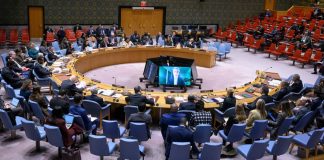

UNITED NATIONS (AP) — The U.N. Security Council voted Tuesday to authorize a much larger, 5,550-member international force with expanded powers to help stop escalating gang violence in Haiti.
The resolution, co-sponsored by the United States and Panama, will transform the current Kenya-led multinational force into a “Gang Suppression Force” with the power to arrest suspected gang members, which the current force does not have.
The vote was 12-0 with Russia, China and Pakistan abstaining.
U.S. Ambassador Mike Waltz said the resolution’s adoption “offers Haiti hope.”
“It is a hope that has been rapidly slipping away as terrorist gangs expanded their territory, raped, pillaged, murdered and terrorized the Haitian population … (and) jeopardized the very existence of the Haitian state,” he said.
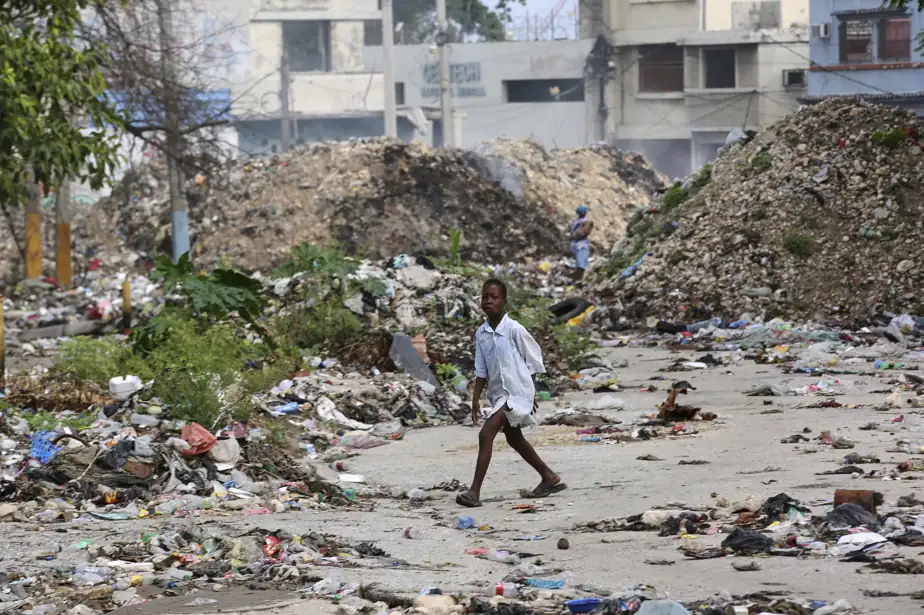
Gangs have grown in power since the assassination of President Jovenel Moïse in 2021. They now control 90% of the capital, Port-au-Prince, and have expanded their activities, including looting, kidnapping, sexual assaults and rape, into the countryside. Haiti has not had a president since the assassination.
The U.S. Embassy in Port-au-Prince said the message from the Security Council is clear: “The era of impunity for those who seek to destabilize Haiti is over.”
Panama’s U.N. Ambassador Eloy Alfaro de Alba said the co-sponsors are convinced that “through this force, it will be possible to re-establish the security that is needed for political reconstruction and the holding of elections,” as well as reviving the economy and creating opportunities for the Haitian people.
But China’s U.N. Ambassador Fu Cong was highly critical of the resolution, which he said “risks exacerbating Haiti’s already complex and dire situation.”
He especially criticized the United States, which he said not only failed to provide promised funding to the Kenya-led force but also owes $800 million to the U.N. peacekeeping budget while demanding that other countries share the financial burden for the new Gang Suppression Force.
Russia’s U.N. Ambassador Vassily Nebenzia said Moscow abstained because the Security Council “is once again being thrust into a dangerous and poorly thought out venture.” Previous U.N. resolutions have failed “to produce any sustainable results, and we have every reason to believe this new mission, under yet another grand title, will meet the same fate,” he said.
The first Kenyans arrived in Haiti in June 2024, and the force was supposed to have 2,500 troops, but it has been plagued by a lack of funding, and its current strength is below 1,000.
The seven-page resolution expresses appreciation to Kenya for leading the multinational force but reaffirms Secretary-General Antonio Guterres’ finding in February that it hasn’t been able to keep pace with the dramatic expansion of the gangs and needs to be scaled up. The mandate for the current force expires on Thursday.
The resolution was adopted under Chapter 7 of the U.N. Charter, which means it can be enforced militarily. It authorizes U.N. member nations to transition to a Gang Suppression Force, in cooperation with Haiti’s government, for an initial period of 12 months.
The new force is authorized to conduct independently or with the Haitian police “intelligence-led targeted, counter-gang operations to neutralize, isolate, and deter gangs that continue to threaten the civilian population, abuse human rights and undermine Haitian institutions.” It is also authorized to provide security for critical infrastructure, including the airport and ports, schools and hospitals, along with the Haitian police and armed forces, and to support Haitian efforts “to combat illicit trafficking and diversion of arms and related material.”
The resolution states that the force would consist of 5,500 uniformed personnel and 50 civilians who would be paid from voluntary contributions. Waltz, the U.S. envoy, urged countries to contribute personnel and money. The resolution asks Guterres to establish a U.N. office to provide logistical and operational support to the new force.
Laurent Saint-Cyr, leader of Haiti’s transitional presidential council, cheered the vote on Tuesday.
“This vote marks a decisive turning point in the fight against armed criminal groups that are causing grief for our families, paralyzing our economy and threatening the future of our nation,” he said.
—-
Danica Coto contributed to this report from San Juan, Puerto Rico.